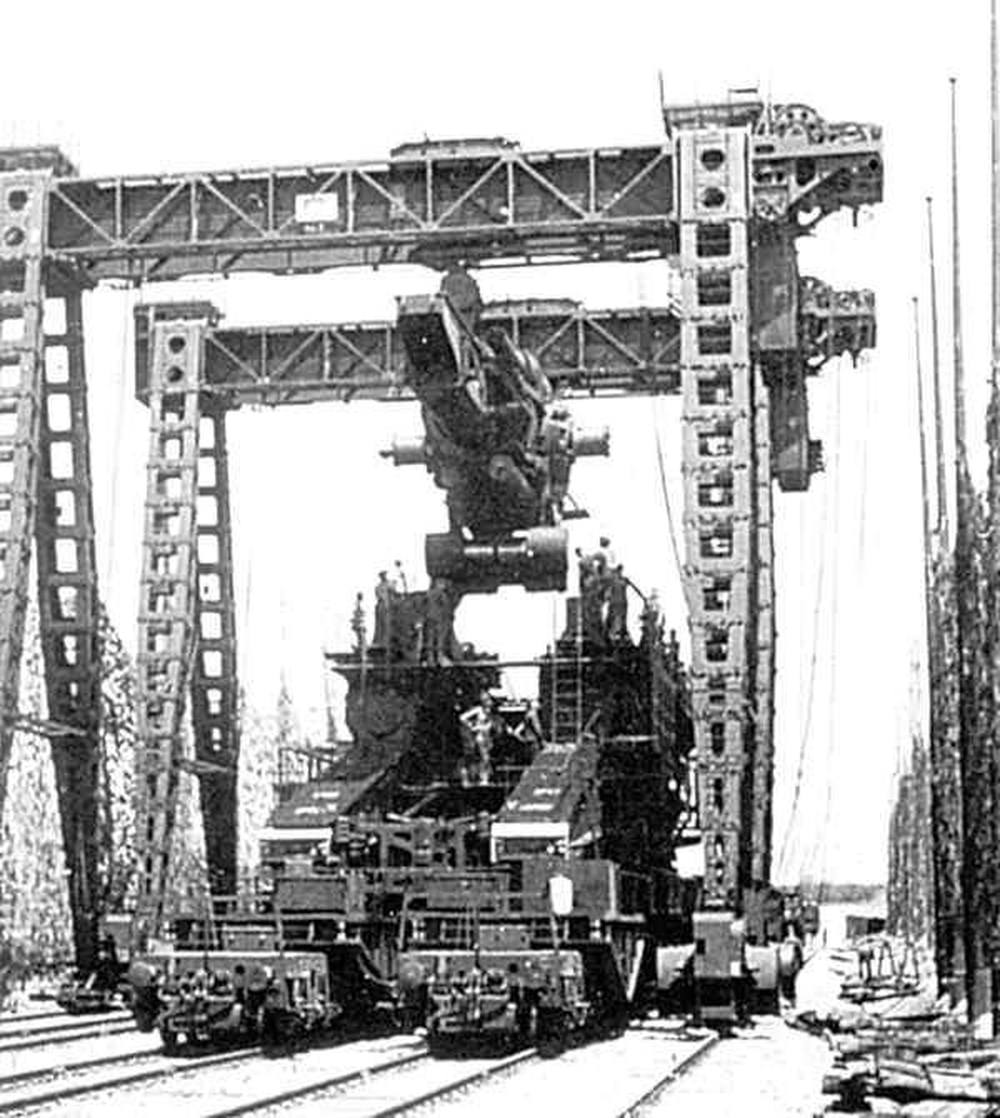
Steel trusses loom overhead as a colossal railway-mounted artillery piece sits beneath a gantry-like framework, its layered platforms, ladders, and machinery forming a fortress of rivets and rails. Tiny human figures and support cars at the base emphasize the overwhelming scale, while the stark contrast of the historical photo makes every beam and bracket feel heavy with purpose. Even without a visible battlefield, the scene conveys the industrial spectacle required to move and service a weapon of this magnitude.
Known popularly as the Gustav Gun, the weapon belonged to a category of super-heavy artillery that pushed Nazi engineering toward extremes of size, logistics, and ambition. The image hints at the hidden story behind such inventions: specialized rail lines, cranes, crews, and a sprawling system of transport and maintenance that mattered as much as the gun itself. What looks like a single machine is really an entire operation, built to turn industrial capacity into long-range destruction.
For readers searching the history of WWII military technology, this photograph offers a sharp entry point into the era’s fascination with “wonder weapons” and oversized solutions. It invites questions about design priorities, practical effectiveness, and the human cost embedded in ambitious engineering projects. As a relic of Nazi engineering inventions, the Gustav Gun stands here not just as hardware, but as evidence of how ideology and industry can fuse into frightening scale.