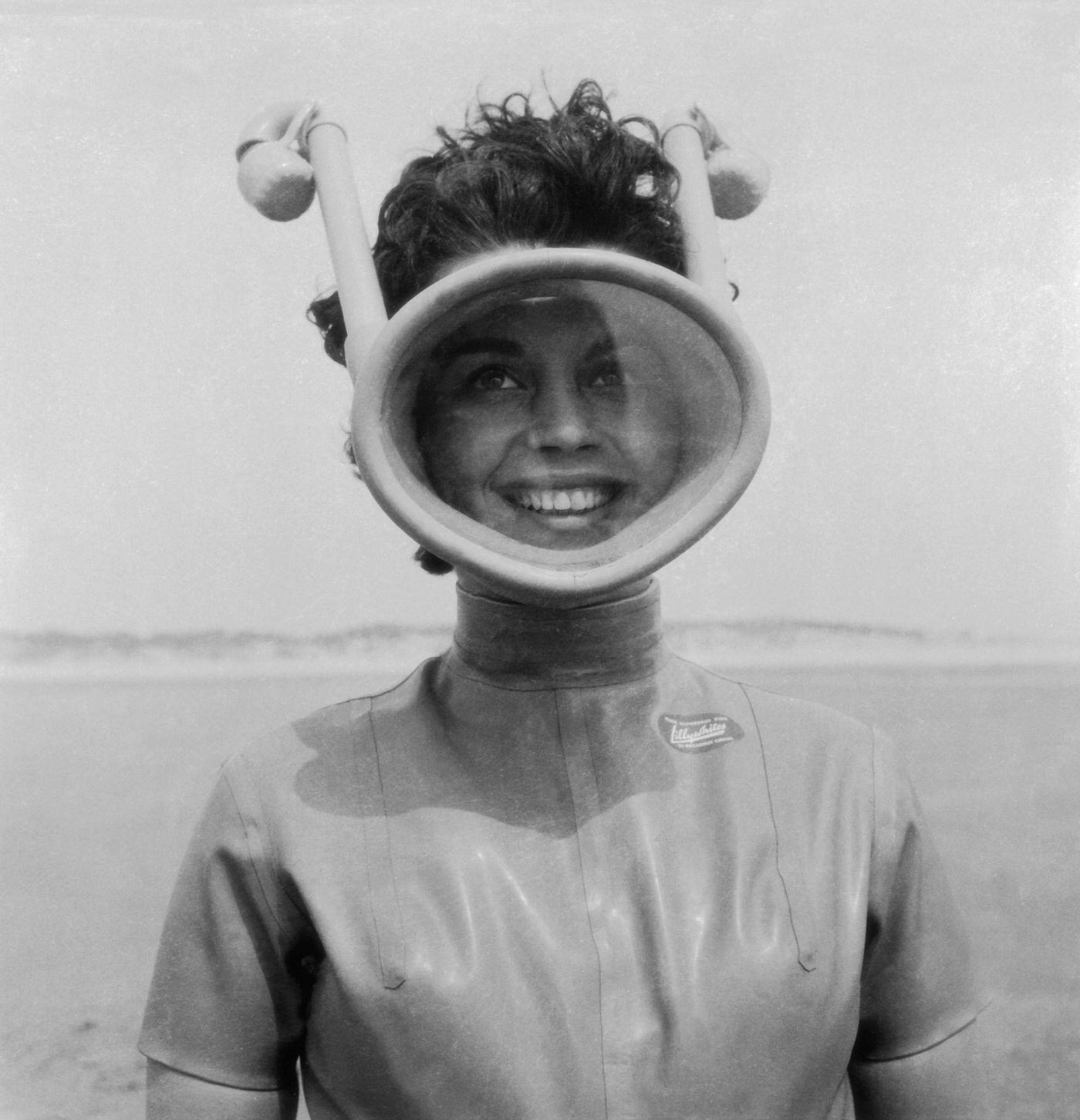
Against a bright shoreline, a diver’s grin is framed by a striking full-face mask that looks more like a porthole than ordinary swim gear. Two snorkel tubes rise on either side of her head, giving the apparatus an almost antennaed silhouette, while the wide viewing window suggests an attempt to make breathing and visibility simpler at the surface. The overall effect is both practical and wonderfully odd, a reminder that innovation often arrives in bold, experimental shapes.
Her smooth, form-fitting water suit—finished with a small chest badge—speaks to an era when recreational diving and coastal leisure were gaining new momentum and manufacturers were racing to refine equipment for comfort and safety. Instead of the familiar mouthpiece-and-goggles combination, this integrated design hints at a transitional moment in the history of snorkeling and early scuba-adjacent technology. Even without technical diagrams, the photograph invites questions about how the mask sealed, how air flowed through those tubes, and what problems the inventor hoped to solve.
Photos like this sit at the intersection of style, engineering, and everyday adventure, making them perfect artifacts for anyone interested in vintage diving gear and the evolution of underwater inventions. The calm sea behind her keeps the focus on the contraption itself—equal parts protective device and conversation piece—while her relaxed expression suggests confidence in the experiment. For collectors, historians, and curious readers, it’s a vivid snapshot of how yesterday’s imaginative prototypes helped shape modern snorkeling masks and wetsuits.