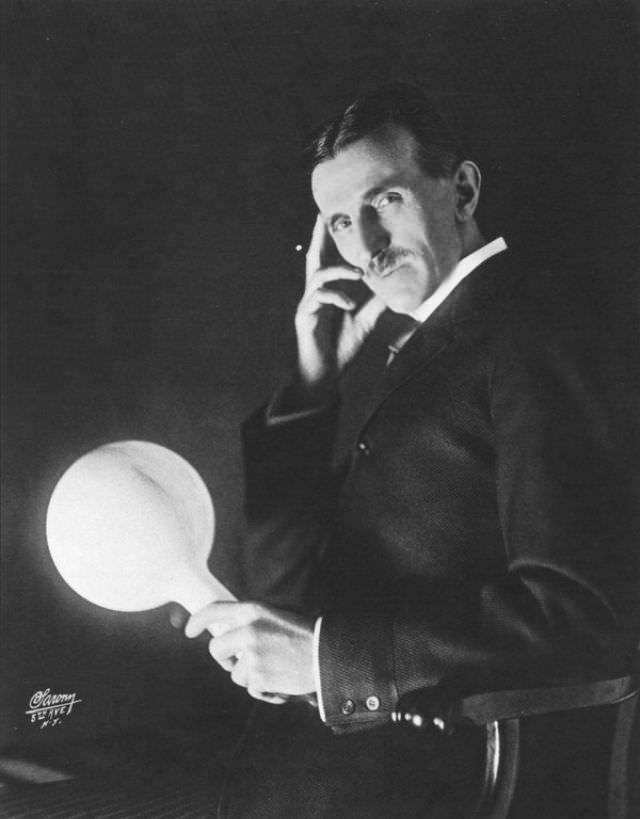
Nikola Tesla poses in a pool of darkness, his face half turned toward the viewer while a brilliant bulb glows in his hand like a captured moon. The contrast is theatrical and deliberate: one hand lifted in thought, the other presenting a glass form that seems to shine without the usual tangle of wires. It’s an instantly recognizable moment from the visual culture of early electrical science, where demonstration and drama often traveled together.
The title points to a gas-filled, phosphor-coated wireless light bulb—an experiment Tesla developed in the 1890s that anticipated later fluorescent lighting by decades. What looks like a simple lamp becomes, in this context, a symbol of high-frequency electricity, luminous gases, and the era’s fascination with making energy visible. The photograph emphasizes the uncanny effect of illumination without conventional connections, reinforcing the idea that the “new electricity” could defy everyday expectations.
Published on the cover of Electrical Experimenter in 1919, the image also speaks to how popular magazines turned laboratory wonders into public spectacle. Readers weren’t just buying technical news; they were buying a story of invention, modernity, and the future of lighting. For anyone searching Tesla photos, early wireless power experiments, or the origins of fluorescent-style illumination, this cover-worthy portrait remains one of the most evocative snapshots of invention in the making.