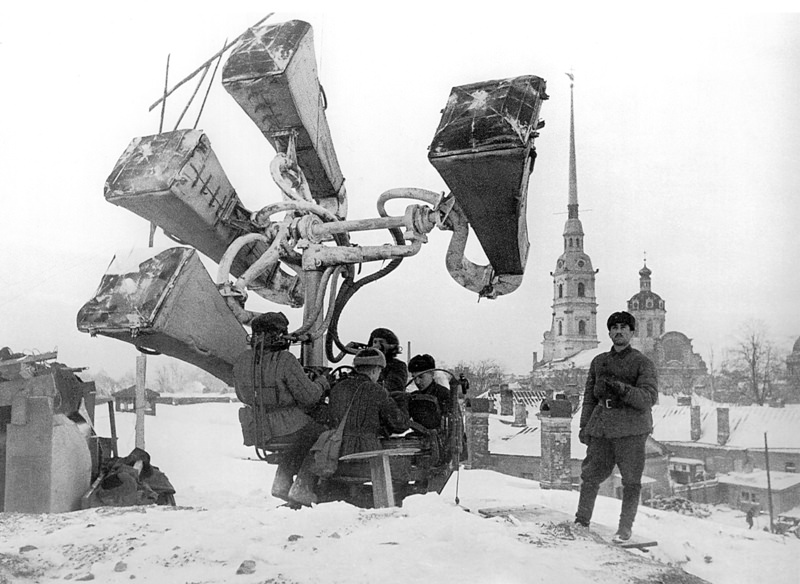
Against a bleak winter skyline, Soviet soldiers cluster around the ZT-4 locator, its oversized horn-like receivers lifted high as if straining for distant engines. Snow blankets the ground and softens the edges of the scene, while the men—bundled in heavy uniforms—work with practiced focus. The title’s 1942 context places this moment inside the wartime push to detect threats early, when the sky itself could turn dangerous without warning.
The ZT-4 represents an era of “listening” technology that bridged older acoustic methods and the rapid rise of radar-based air defense. Instead of looking upward for aircraft, crews relied on directional sound, adjusting the device to isolate faint signals and estimate approach. It’s a vivid reminder that invention on the battlefield wasn’t always sleek or invisible; sometimes it was mechanical, bulky, and deeply dependent on human ears, patience, and coordination.
In the background, church towers punctuate the horizon, an architectural counterpoint to the improvised, utilitarian hardware in the foreground. That contrast—sacred stone and wartime machinery—adds emotional weight to an otherwise technical subject, anchoring military innovation in a lived landscape of towns and rooftops. For readers interested in WWII technology, Soviet air defense, and the history of early detection devices, this photograph offers an evocative window into how soldiers tried to hear the future coming.