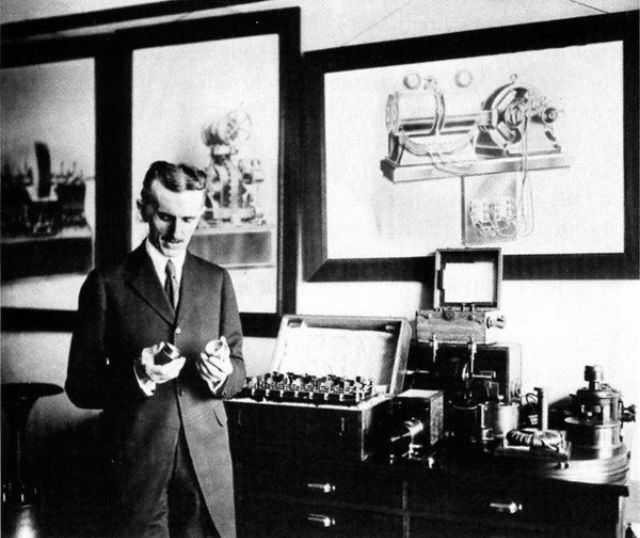
Nikola Tesla stands in his New York City office in 1916, dressed formally yet absorbed in the small object turning in his hands, as if testing an idea in miniature before letting it loose on the world. The room around him feels like a working laboratory rather than a posed studio: instruments crowd the desk, cabinets sit heavy with equipment, and framed diagrams loom like silent collaborators. For anyone searching for a Tesla photo from this period, the scene offers an intimate glimpse of the inventor at work, surrounded by the practical clutter of experimentation.
Behind him, the drawings on the wall point directly to engineering ambition, depicting a steam engine design that anchors the photograph in the language of invention. Technical sketches and apparatus share the same space, hinting at the way Tesla moved between concept and mechanism—thought becoming line, line becoming machine. Details like the dense array of components and the orderly arrangement of devices help explain why his office life remains such a compelling subject in the history of technology.
Just across the street, Bryant Park offered a very different kind of routine, and the title’s note about Tesla feeding pigeons adds a human counterpoint to the instruments and schematics. That small habit suggests a man stepping out of intense solitary work into the public air of Manhattan, carrying his attention from engines and experiments to the everyday life of the city. As a historical image, it balances myth and reality: Tesla the visionary inside the office, and Tesla the New Yorker outside it, returning again and again to the same park paths.