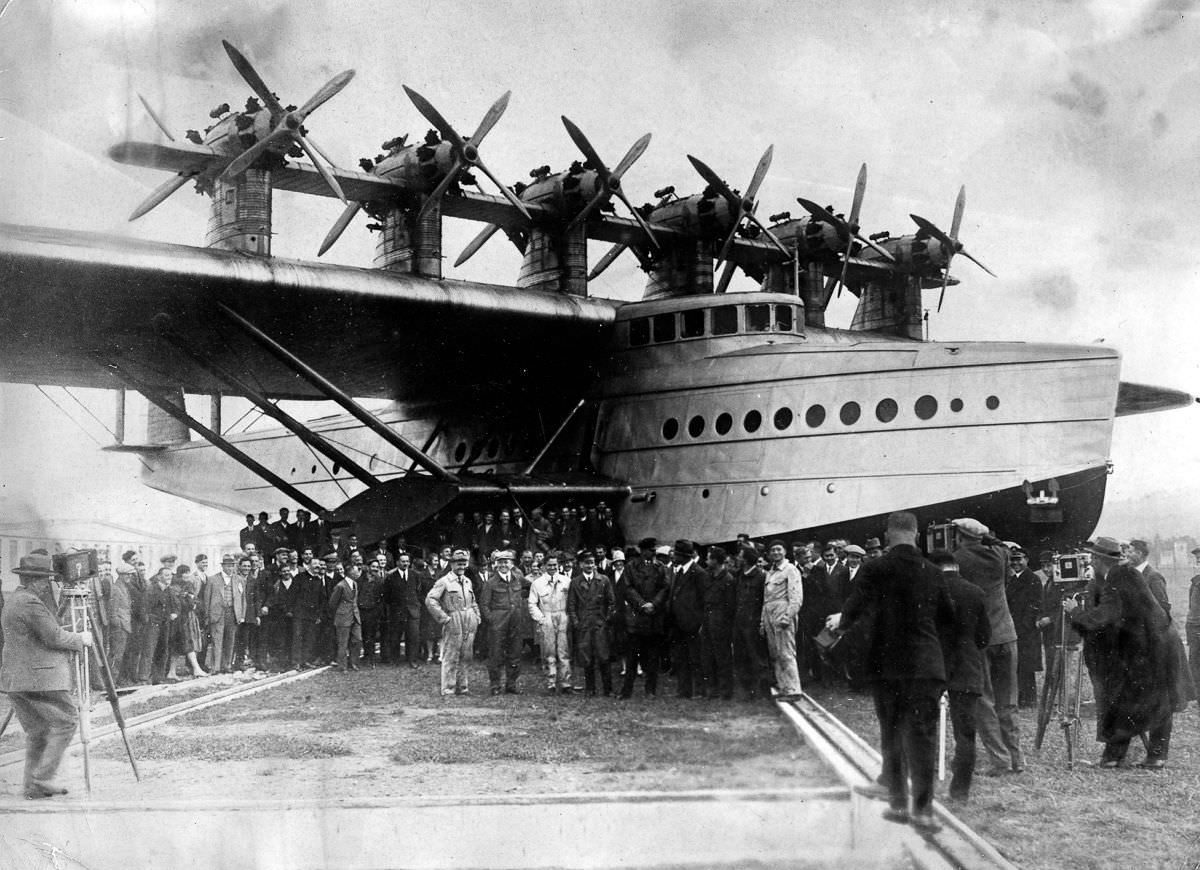
Steel, rivets, and ambition dominate the scene on Oct. 21, 1929, as a colossal flying boat looms over a tightly packed crowd of onlookers. Multiple propellers sit in a row atop the thick wing, their engines mounted like a mechanical skyline above the hull’s long line of round portholes. At ground level, men in suits, coats, and caps gather shoulder to shoulder, while a few photographers with tripod cameras frame the moment as if recording the future arriving on a runway.
What makes the photograph so compelling is the contrast between human scale and machine scale: tiny figures stand beneath a structure that looks part aircraft, part ship. The hull’s boat-like form hints at the era’s confidence in water landings and long-distance travel, when aviation and maritime engineering were merging into a single bold idea. Even without a visible nameplate, the design speaks to late-1920s experimentation—big airframes, many engines, and the belief that more power meant more reach.
In the spirit of “Inventions,” this image offers a snapshot of innovation culture itself: a public unveiling where technology becomes spectacle and progress is something you can walk up to and touch. It’s also a reminder that 1929 was a year balanced between optimism and uncertainty, with engineering pushing forward at full throttle. For readers searching for early aviation history, vintage aircraft technology, or the development of seaplanes and flying boats, this photograph captures the moment when imagination, industry, and crowds converged around a groundbreaking machine.