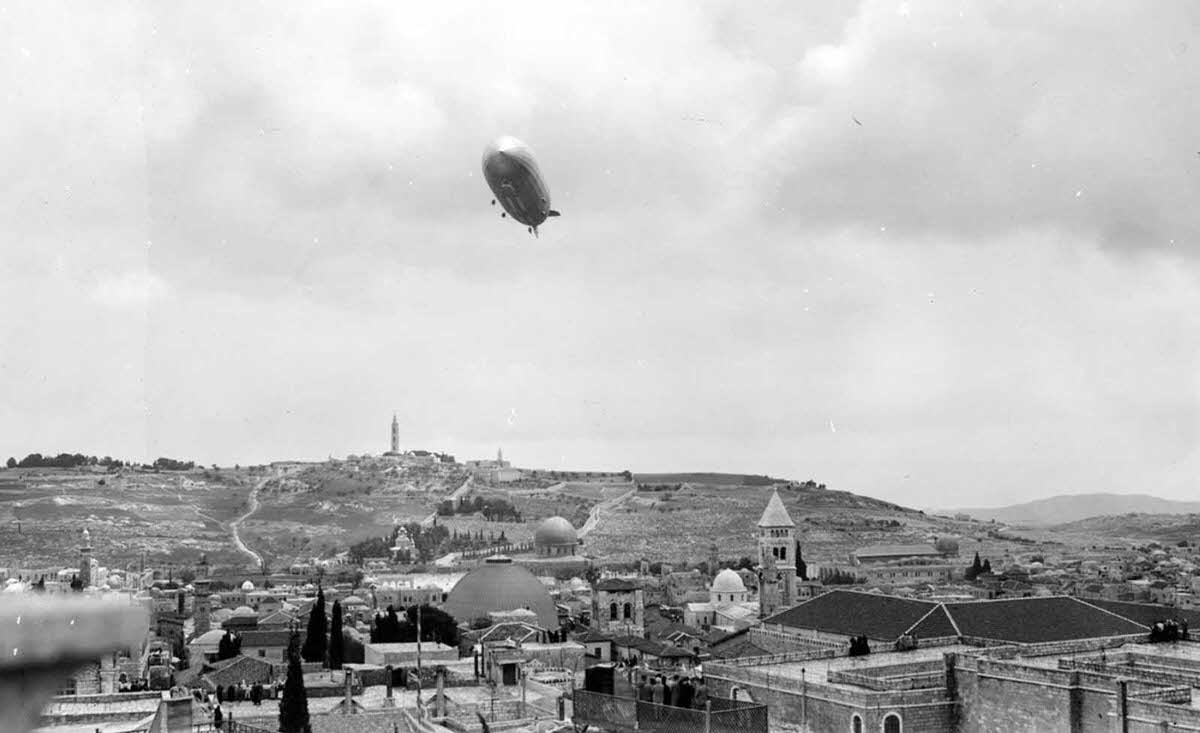
High above Jerusalem’s layered rooftops, the Graf Zeppelin drifts through a pale spring sky on April 26, 1931, its long silhouette dwarfed by clouds yet impossible to ignore. Below, domes, towers, and tightly packed stone buildings form a dense patchwork that speaks to centuries of worship, work, and daily life. The photograph’s wide view lets the airship feel like a visitor from another age, hovering over an old city that seems both familiar and timeless.
The scene is rich with contrasts: modern engineering floating over ancient streets, clean lines of an airship set against irregular rooflines and weathered masonry. A hillside rises beyond the urban core, and the city’s skyline is punctuated by spires and rounded cupolas that catch the light in soft gradations. Even without close-up faces or bustling movement, the image suggests a moment when residents and travelers alike would have looked up, startled by the quiet presence of this technological marvel.
As a piece of aviation history, the Graf Zeppelin’s passage over Jerusalem captures the interwar fascination with “inventions” that promised to shrink distance and redefine travel. Airships symbolized prestige, speed, and the romance of flight, while the city below represented continuity—sacred architecture and enduring neighborhoods anchored to the landscape. For readers searching for Graf Zeppelin Jerusalem 1931 or early airship photography, this rare vantage offers an evocative meeting point between innovation and heritage.