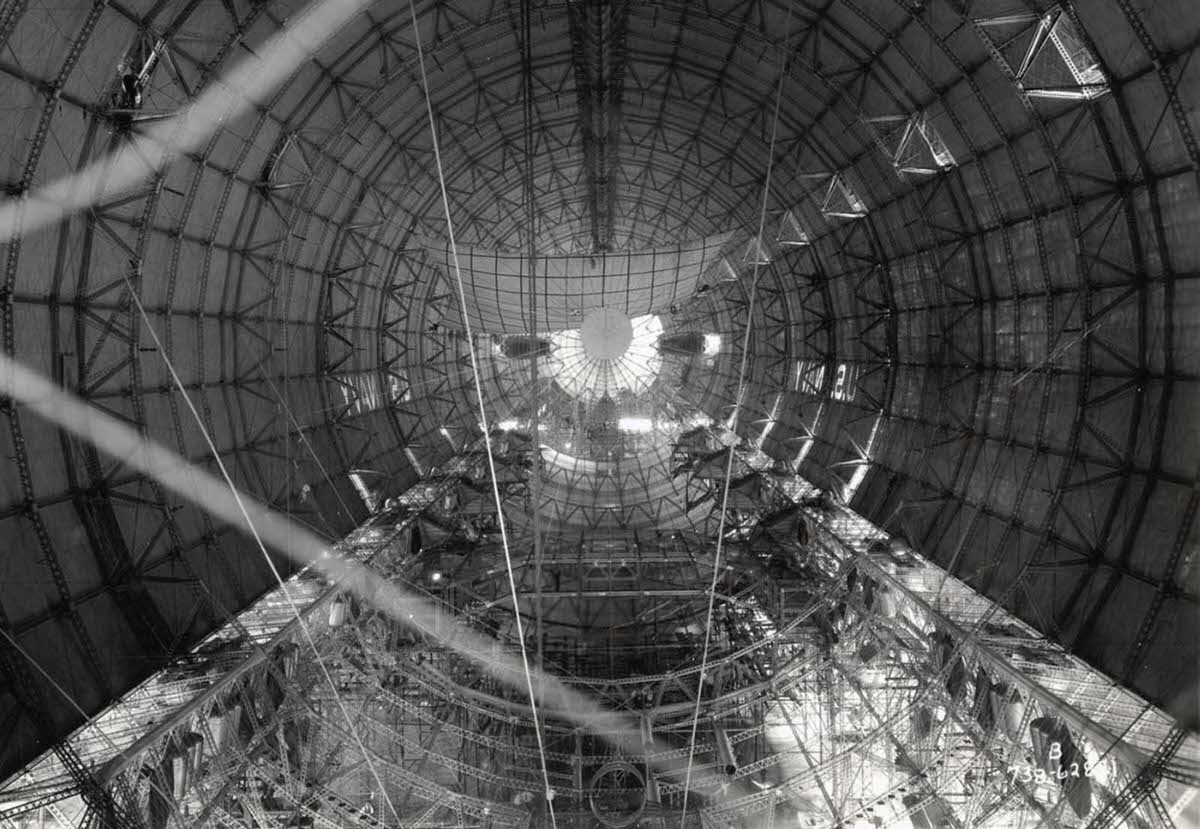
Steel ribs arc overhead in a vast, cathedral-like curve, revealing the interior hull of a U.S. Navy dirigible under construction around 1933, before its gas cells were installed. The camera peers down the length of the structure toward a bright circular opening, where light pours in and turns the framework into a lattice of lines and shadows. Suspended cables slice through the space, hinting at the careful rigging needed to assemble something this enormous.
Without the fabric gas bags in place, the airship’s anatomy is laid bare: rings, longitudinal girders, and bracing members forming a rigid skeleton designed to hold shape in flight. Catwalks and platforms cling to the inner walls, creating working levels for crews to reach fittings, wiring, and attachment points deep inside the hull. The stark contrast of metal against light emphasizes how much of an airship’s “body” was engineering before it was ever lift.
Viewed today, the photograph reads like a blueprint made three-dimensional—part industrial art, part evidence of an era when lighter-than-air craft sat at the cutting edge of naval aviation. It also offers a practical glimpse into the staging of dirigible construction, when empty volume had to be navigated and controlled long before helium-filled cells transformed the framework into a buoyant vessel. For readers interested in inventions, military technology, or the history of airships, this interior scene captures the scale and complexity that made these machines both impressive and demanding to build.