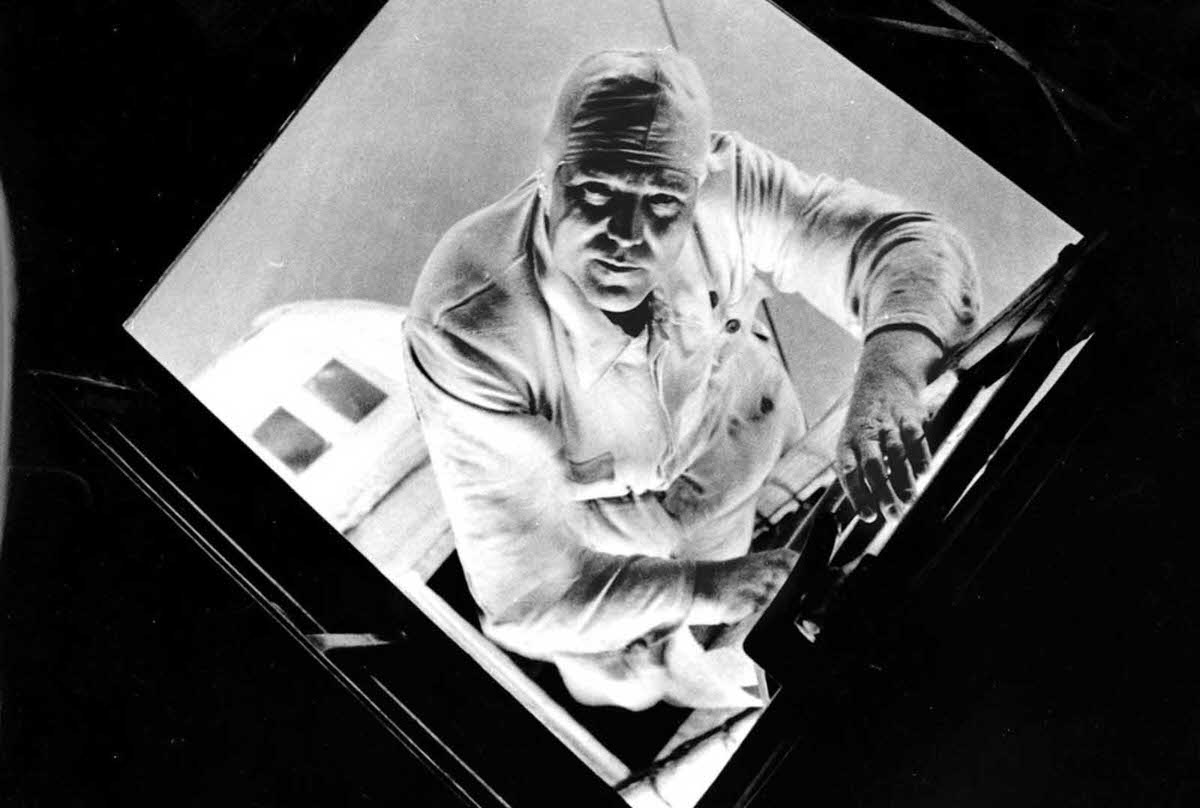
High above the ground, a mechanic in work clothes and cap hauls himself up through a tight hatch, his hands finding purchase on a ladder as the airship’s skin and framework press in around him. The camera looks down into the opening, turning a routine climb into a dramatic moment of industrial theatre—one man framed by geometry, shadow, and the bright rectangle of the access panel. It’s an intimate view of aviation history where the human figure, not the aircraft, becomes the central machine.
According to the title, this is the rear engine gondola, the compartment that housed power and propulsion equipment on many large airships. A “shift change” inside the mantle hints at continuous operations: engines demanded attention, inspection, and constant adjustment, and crews rotated through narrow passages far from the comfort of the main control spaces. The photo’s stark contrast emphasizes the practical realities of lighter-than-air invention—maintenance performed in confined quarters, surrounded by metal struts, cables, and the hidden systems that kept an airship moving.
What makes the scene memorable is its focus on labor rather than spectacle, offering a rare perspective on airship mechanics and the people who made early aviation possible. For readers interested in inventions, engineering, or the working life aboard dirigibles, the image evokes the routine risks of climbing, balancing, and troubleshooting while suspended within a massive flying structure. It’s a reminder that every celebrated flight depended on skilled hands in places few passengers ever saw.