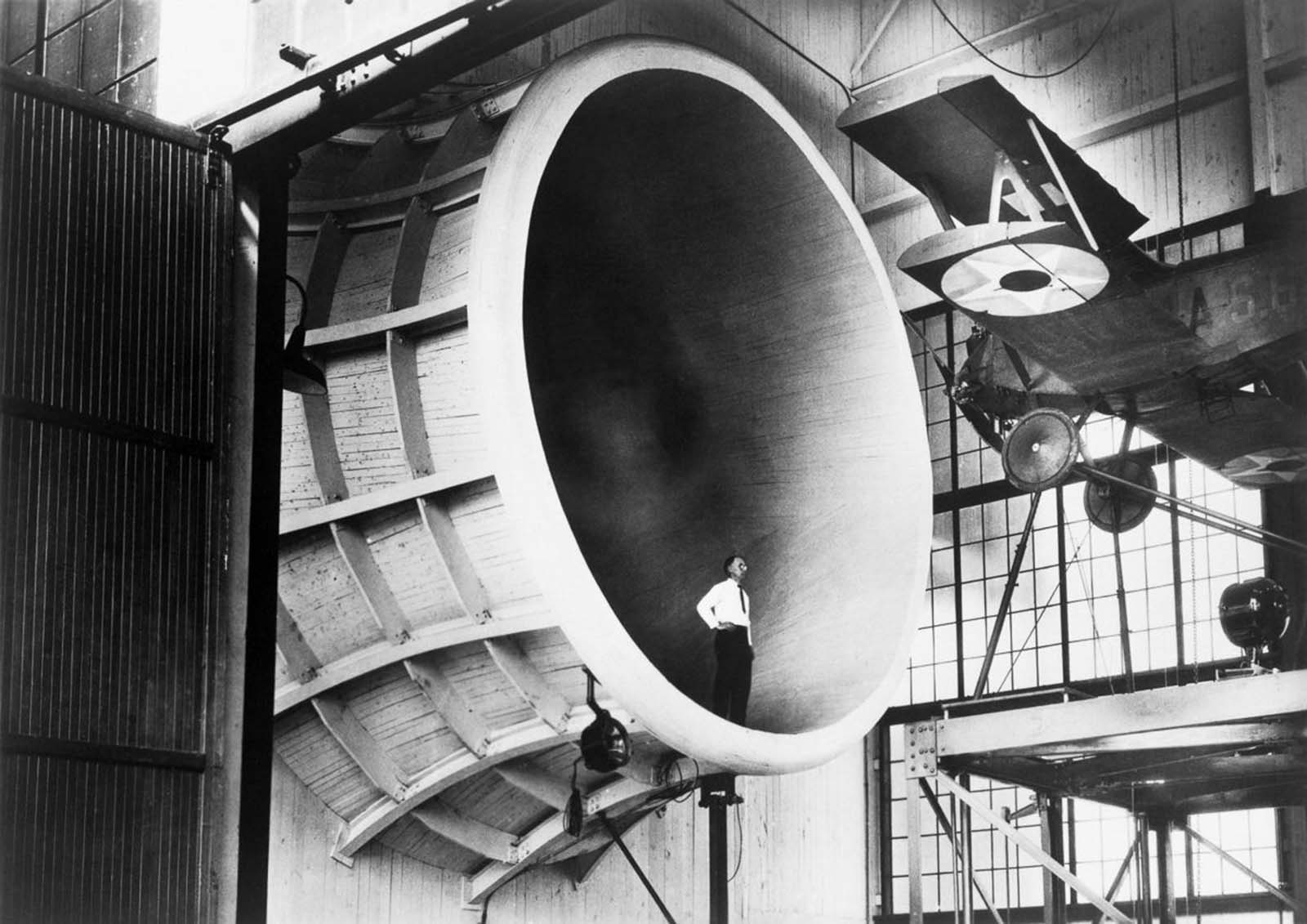
Dominating the frame is the yawning circular mouth of Langley’s Propeller Research Tunnel, its smooth interior and heavy framing turning an ordinary hangar into something that feels almost cathedral-like. A lone researcher stands inside the opening for scale, dwarfed by the engineering around him and emphasizing just how ambitious full-scale aeronautical testing had become by 1927. The stark contrast of light through tall industrial windows highlights the tunnel’s clean lines, riveted structure, and the purposeful order of a working laboratory.
To the right, suspended high above the floor, the Sperry M-1 Messenger hangs as both subject and instrument—an airplane positioned not for flight, but for measurement. Struts, cables, and rigging connect the aircraft to the test setup, suggesting careful control over angle, airflow, and propeller behavior as engineers sought repeatable results. Seen this way, early aviation becomes less a tale of daring pilots and more a story of disciplined experimentation where performance could be studied, improved, and standardized.
For readers searching the history of wind tunnels, Langley research, and 1920s aircraft development, this photograph underscores a milestone: the first full-scale airplane tested in the Propeller Research Tunnel. The scene captures the transition from small models to real airframes, when laboratories began to shape what airplanes would become long before they left the ground. It’s an evocative glimpse of invention in practice—where a single human figure, a modest aircraft, and an immense machine meet at the edge of modern aeronautics.