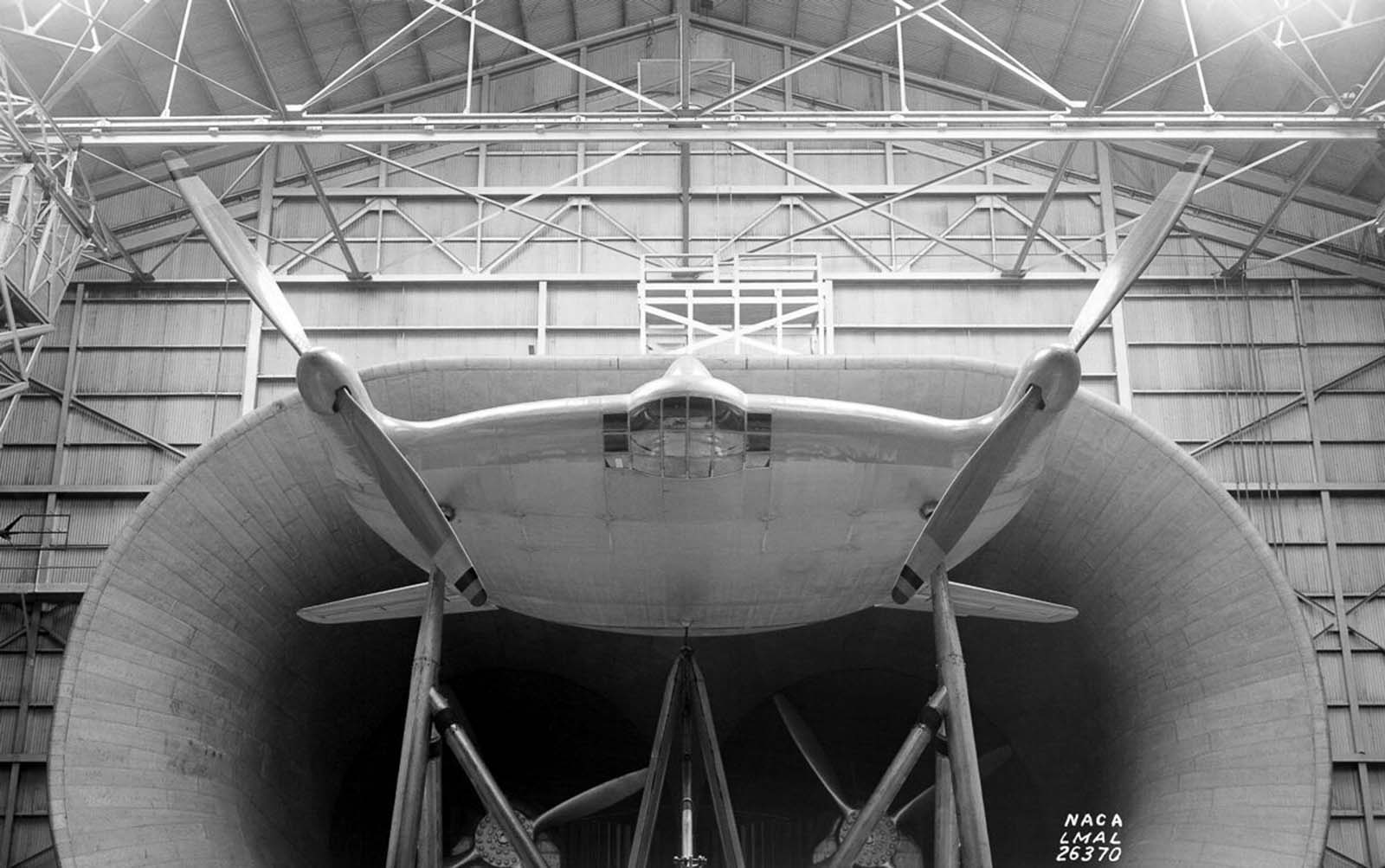
Dominating the frame like a flying saucer set on scaffolding, the Vought-Sikorsky V-173 prototype sits mounted at the mouth of the Full Scale Wind Tunnel in 1941. Its broad, circular wing blends into a compact fuselage, while two large propellers flank the aircraft with blades poised for testing rather than takeoff. Above and around it, the tunnel’s steel trusses and industrial lighting emphasize the controlled, laboratory-like world where aeronautical ideas were pushed to their limits.
Seen from this low, head-on angle, the aircraft’s “pancake” planform becomes the story: maximum lifting area packed into a short span, with the cockpit perched near the centerline and the wing swelling outward into rounded edges. The mounting struts and bracing beneath the body remind us that this is an experiment in motionless flight—airflow recreated by machinery, measured and recorded, then translated into design changes. Even in stillness, the image suggests the questions engineers were chasing: stability at low speed, propeller slipstream effects, and how unconventional shapes might behave when the air turns turbulent.
A moment like this belongs to the broader history of American aviation research, when NACA facilities and manufacturer prototypes met in the wind tunnel to refine concepts before risking them in the sky. For readers interested in WWII-era engineering, experimental aircraft, and the evolution of VTOL and short takeoff thinking, the V-173 stands as a vivid waypoint. The photo’s stark geometry—curved tunnel throat, round wing, and rigid supports—captures an era when invention looked strange, ambitious, and wonderfully unafraid to break the silhouette of the typical airplane.