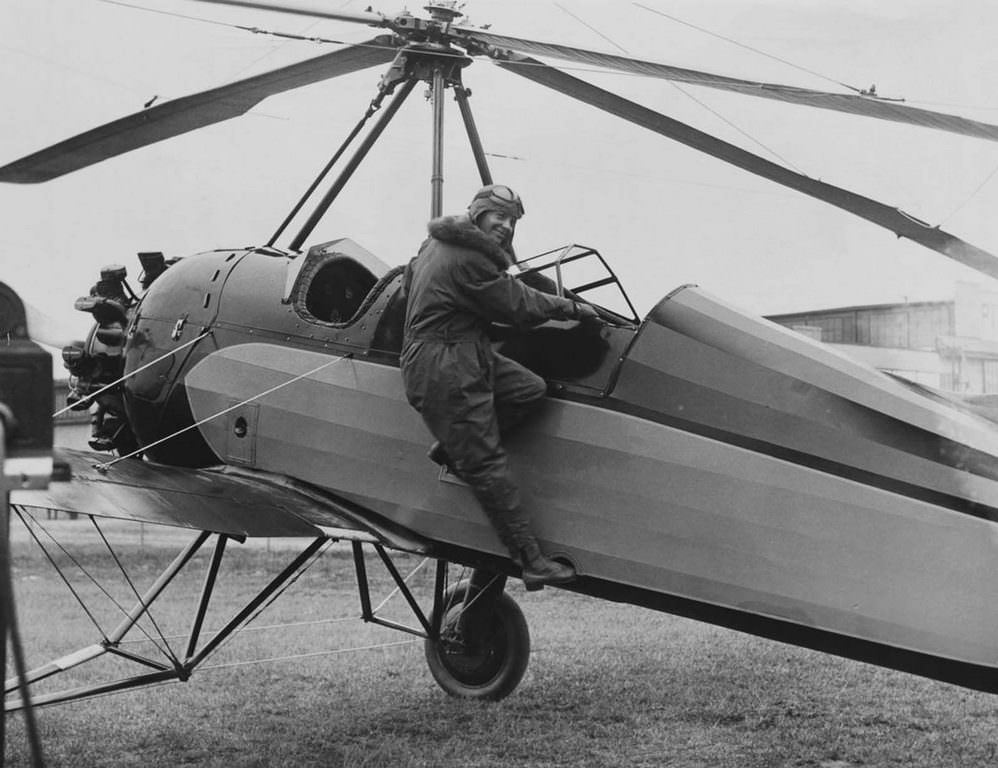
Leather helmet fastened and one boot on the step, Amelia Earhart climbs into an autogyro with the calm purpose of someone who knows the machine as well as the sky. The aircraft’s long fuselage and spindly landing gear stretch across the frame, while the rotor mast rises above her like a mechanical crown. In the background, hangar buildings sit low on the horizon, emphasizing the open airfield where aviation’s next experiments were often staged.
Autogyros occupied an intriguing middle ground between airplane and helicopter, relying on an unpowered rotor for lift while a conventional propeller drove them forward. That blend of innovation and practicality made them a magnet for pilots eager to test new possibilities in flight. Earhart’s hands-on engagement with such technology helped turn “inventions” from workshop curiosities into public-facing proof that aircraft design was evolving fast.
In April 1931, she used an autogyro to set a women’s altitude record of 18,415 feet, a milestone that linked her personal daring to a broader story of aeronautical progress. The photograph hints at the physical realities behind the headlines: heavy flight gear, a narrow cockpit opening, and the careful climb into place before the engine ever turns. For readers interested in Amelia Earhart, early rotorcraft, and the history of record-setting aviation, this moment stands as a vivid snapshot of ambition meeting engineering.