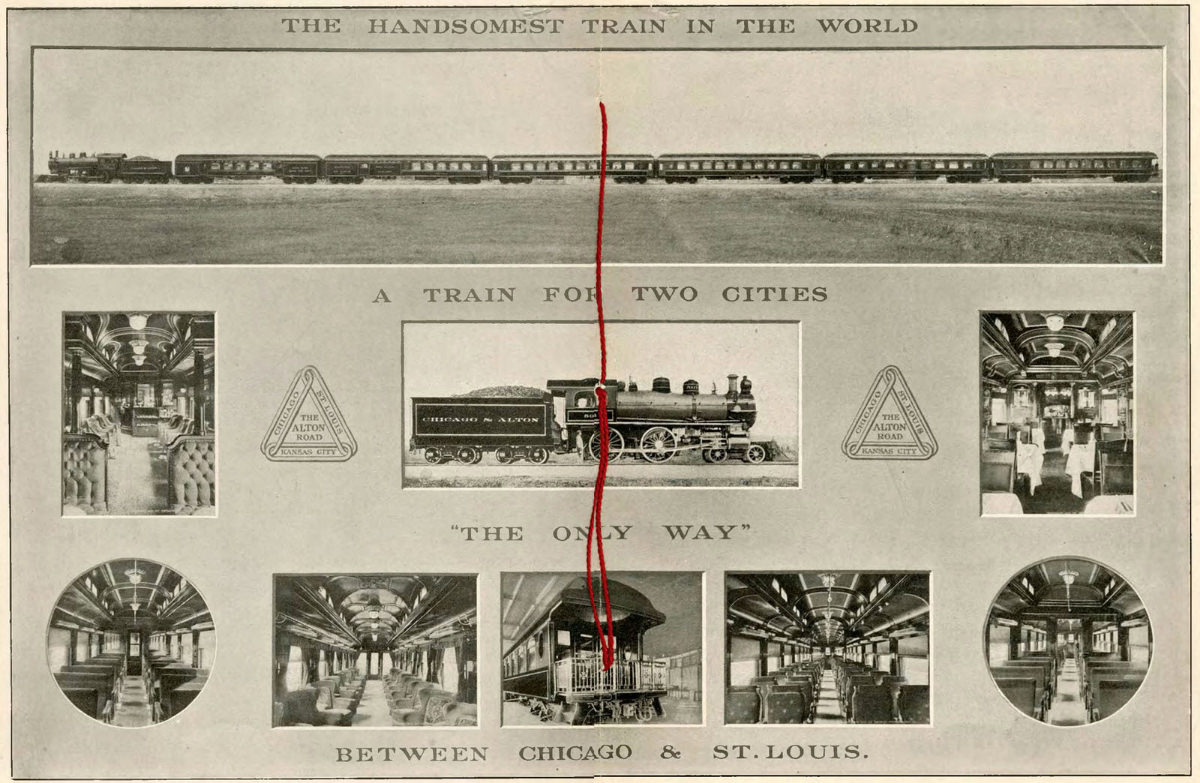
Bold typography crowns the spread with the claim “The Handsomest Train in the World,” a slogan that doubles as a sales pitch and a window into the era’s faith in rail travel as modern wonder. Across the top runs a long, panoramic view of a full passenger consist stretched nearly end to end, presented like a trophy of engineering. The layout itself feels like an invention—part advertisement, part visual proof—designed to impress at a glance and linger in memory.
At the center, a locomotive and tender labeled “Chicago & Alton” anchors the page beneath the line “A Train for Two Cities,” linking the imagery directly to intercity ambition. Flanking and surrounding it are interior photographs: plush seating, bright lamps, polished woodwork, and orderly aisles that suggest comfort as carefully manufactured as speed. Even the repeated emblems and symmetrical framing reinforce the message that this railroad offered a standardized, dependable experience.
Along the bottom, the words “Between Chicago & St. Louis” and the emphatic phrase “The Only Way” sharpen the promotional edge, turning aesthetics into competition. As a piece of printed ephemera, this Chicago & Alton pamphlet spread shows how railroads used photography—especially striking, oversized images like Lawrence’s—to transform machinery into desire. For readers interested in inventions, advertising history, or the visual culture of transportation, it’s a compact lesson in how progress was sold one meticulously composed photograph at a time.