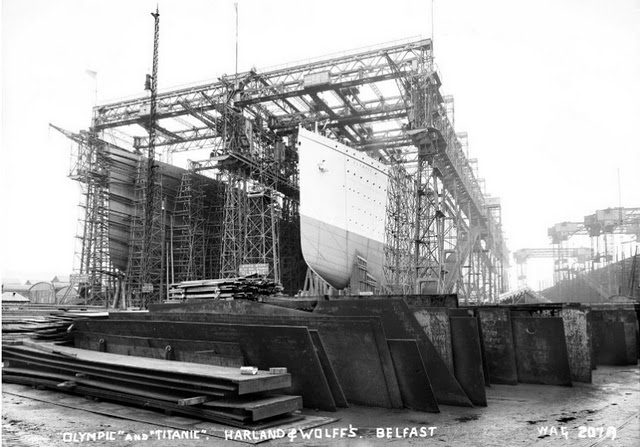
Steel plates lie stacked in the foreground while an immense ship’s hull rises behind a forest of scaffolding and gantries, turning the shipyard into an industrial cathedral. The caption along the bottom identifies “Olympic” and “Titanic” at Harland & Wolff’s in Belfast, anchoring the scene in the era when ocean liners were built like monuments. Rivet lines and raw metal surfaces hint at the painstaking work of shaping a leviathan from thousands of parts, long before polished interiors and public fanfare.
Beyond the romance of the name, the photograph draws attention to the practical inventions and engineering methods that made such a vessel possible: heavy-lift cranes, modular assembly in vast slipways, and the disciplined choreography of crews fitting plates, frames, and bulkheads. Every beam of the overhead structure suggests the scale of the challenge—lifting, aligning, and fastening components with precision while the hull grew day by day. It’s a reminder that the “unsinkable” reputation was forged as much in workshops and drafting rooms as in newspaper headlines.
For readers searching Titanic construction photos, Harland and Wolff history, or early 20th-century shipbuilding, this image offers a grounded look at how fame began—before the maiden voyage, before legend, when innovation was measured in rivets and reach. The unfinished bow and the surrounding latticework invite you to imagine the noise, heat, and urgency of a yard racing to complete a ship meant to embody modernity. Here, the rise to fame starts not on the sea, but on the slip, where invention and ambition met in steel.