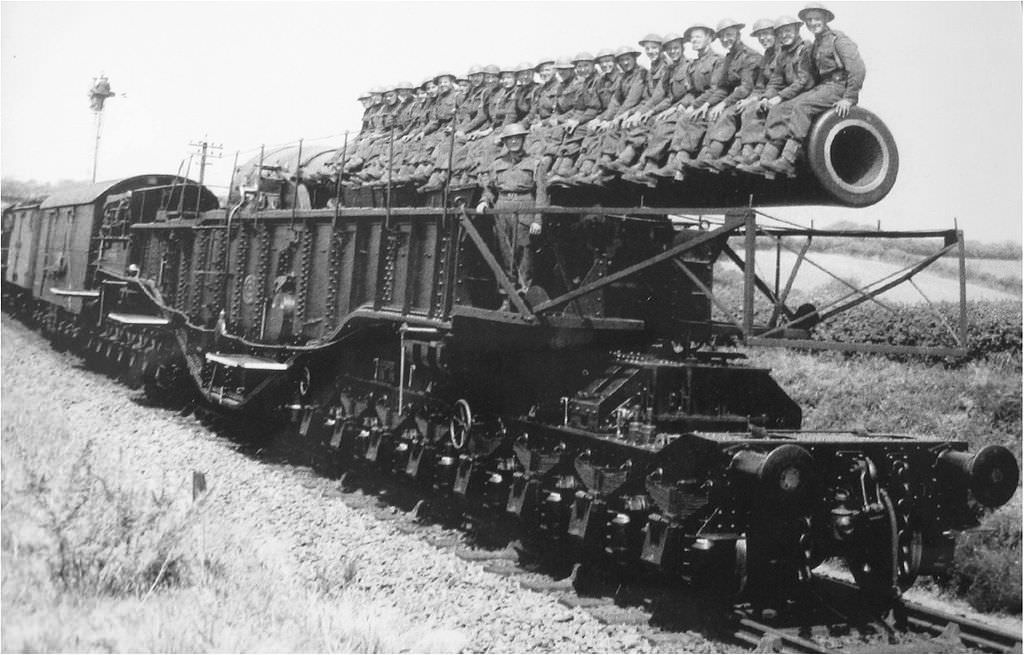
A line of soldiers perches casually along the length of a colossal gun barrel, their bodies turned into a measuring stick for scale. Mounted on a railway platform and surrounded by the scaffolding and fittings needed to handle its enormous weight, the weapon dominates the frame with an almost industrial bluntness. Even without captions, the sheer diameter of the muzzle and the dense machinery beneath it advertise an age when “bigger” was treated as a strategy.
The Gustav Gun belongs to the category of Nazi engineering inventions that blurred the boundary between technical ambition and battlefield practicality. Rail-mounted superguns demanded specialized tracks, crews, and logistics, turning every movement and firing cycle into a major operation. Photographs like this one are as much about the supporting infrastructure—cars, braces, mechanisms, and labor—as they are about the cannon itself, underscoring how modern warfare increasingly relied on systems rather than single machines.
Seen today, the image invites mixed reactions: awe at the engineering and unease at the purpose behind it. That tension is part of why the Gustav Gun remains an astonishing relic in World War II history, frequently cited in discussions of extreme artillery and military technology. As a visual document, it preserves a moment when propaganda-worthy scale and mechanical complexity were leveraged to project power, leaving historians to weigh spectacle against reality.