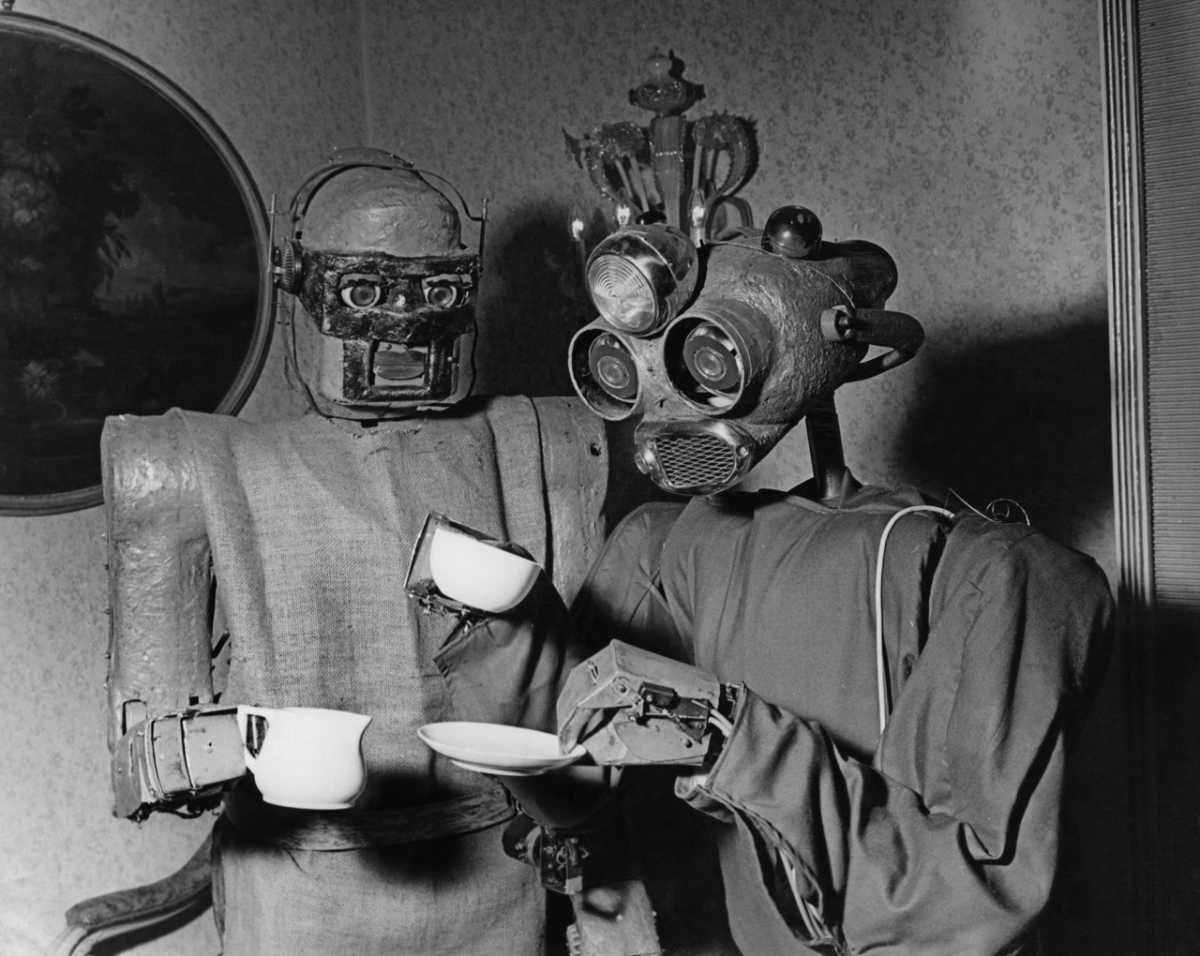
Oddly endearing and a little uncanny, the MM7 Selektor robot appears here as a pair of homemade “house helpers,” their bulky heads fitted with lens-like eyes and their torsos dressed in everyday shirts as if ready to step into domestic routine. One figure seems to wear headphone-style bands, while the other’s face resembles a cluster of mechanical “senses,” suggesting an inventor’s attempt to give a machine awareness and purpose. Set against a modest interior backdrop, the scene blurs the line between workshop experiment and living-room performance.
Claus Scholz-Nauendorff’s invention, as the title frames it, belongs to that long moment when technology promised to revolutionize housework, turning repetitive chores into tasks delegated to clever devices. The staged presentation—cups and saucers held out like a polite service—signals the era’s fascination with automation not just in factories, but at home, where comfort and modernity were becoming selling points. Rather than sleek futurism, the MM7 Selektor’s charm lies in its visible improvisation: parts, casings, and attachments that read as practical problem-solving and bold imagination.
Search for early home robot prototypes and you’ll find a recurring theme: the dream of a tireless assistant, embodied here in a machine that looks both mechanical and strangely human in posture. This historical photo invites viewers to consider what “labor-saving” meant in practice, and how inventors staged their creations to make the future feel close at hand. For readers interested in household technology, retro robotics, and the cultural history of inventions, the MM7 Selektor offers a vivid snapshot of ambition—one cup and saucer at a time.