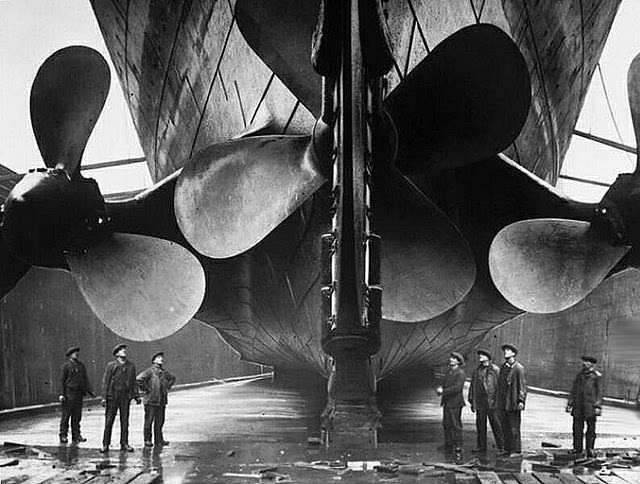
Beneath the towering stern of a newly built ocean liner, three immense propellers dominate the frame, their blades gleaming against the dark curve of the hull. A line of workers stands on the dock below, dwarfed by the machinery overhead, turning a routine moment in a shipyard into a startling measure of scale. The composition draws the eye inward toward the propeller shafts and the tight geometry of steel, rivets, and shadow—an industrial cathedral built for speed and prestige.
During the era that produced the Titanic, shipbuilders sold more than passage across the Atlantic; they marketed confidence in modern engineering. Scenes like this hint at the hidden labor and heavy inventions behind the glamour: massive propulsion systems designed to push unprecedented weight through rough water, and a hull crafted to project strength as much as luxury. The men at the waterline remind us that “unsinkable” was as much a promise born of progress and pride as it was a reflection of public faith in new technology.
For readers tracing the story of Titanic’s construction and rise to fame, the photograph works as a grounded counterpoint to the myth—less ballroom, more boiler room. It invites a closer look at what made early 20th-century shipbuilding revolutionary, from the scale of its components to the precision demanded by marine engineering. In a WordPress post about Titanic inventions, this kind of historical image helps anchor the narrative in the practical realities of how such a legendary liner was actually built.