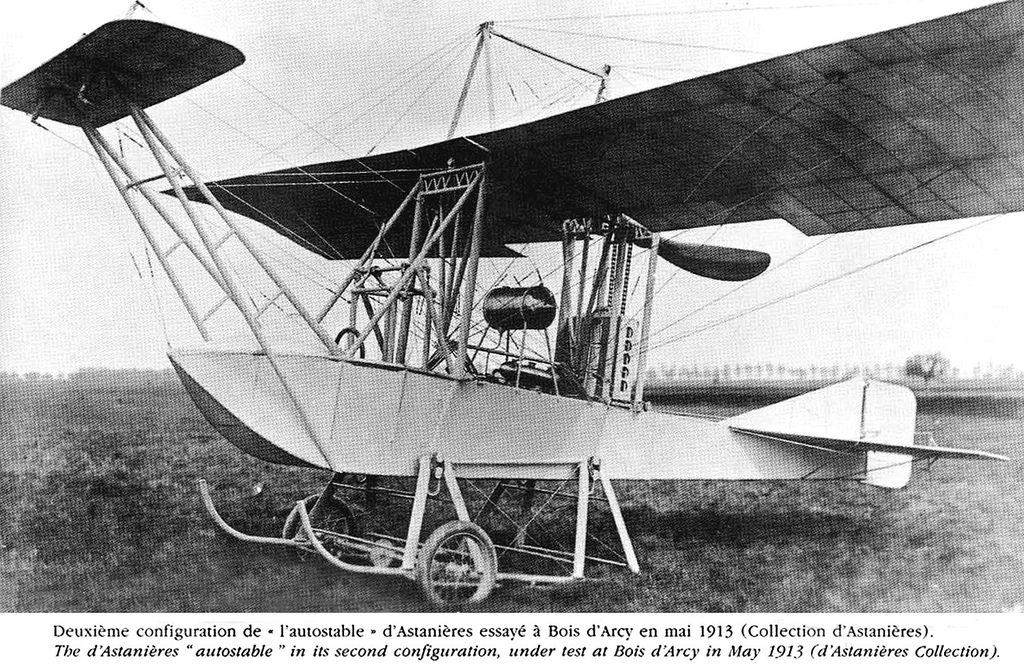
Oddly named yet instantly intriguing, the “Autostable” appears here as a bold early aviation experiment—part aircraft, part mechanical thought experiment—caught on the ground with its rigging, struts, and broad wings carefully arranged for a test. The craft’s unusual undercarriage, with sled-like runners and wheels, hints at the era’s constant worry about rough fields and unpredictable takeoffs. Even at rest, the machine looks tense with purpose, as though every wire and spar has been placed to coax stability from an unruly sky.
A close look rewards the eye with period details: a compact framework of bracing, a slender tail assembly, and an exposed engine area that speaks to hands-on engineering rather than streamlined design. The photo’s captioning points to French testing and uses the term “second configuration,” suggesting iterative redesign—an inventor’s willingness to revise, rebuild, and try again. That spirit of trial is central to the history of flight, when “inventions” were rarely finished products and more often evolving solutions to lift, control, and safety.
For readers interested in the history of aviation technology, Autostable offers a vivid snapshot of how experimental aircraft were conceived before standard layouts took hold. The emphasis implied by the title—stability—reflects a major challenge of early flight, when keeping an airplane controllable could matter as much as getting it airborne. Seen today, this historical photo invites us to imagine the test ground, the mechanics’ adjustments, and the hope that a new arrangement of wings, wires, and supports might finally make flying feel dependable.