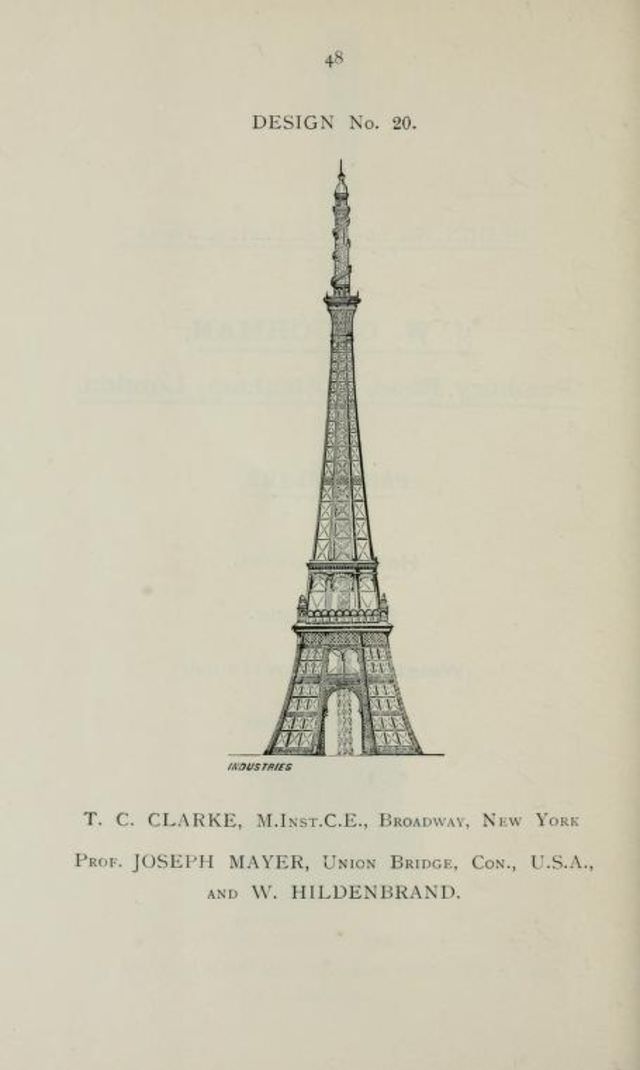
Design No. 20 rises from the page like a confident answer to an era obsessed with height, engineering, and civic spectacle. The drawing proposes a lattice-work tower with a broad arched base, tiered platforms, and a slim spire that finishes in a small finial—an unmistakably 1890s blend of industrial structure and ornamental ambition. Even in this simple print, the careful linework suggests riveted metal, repeating braces, and the kind of calculated symmetry meant to impress judges and investors alike.
Beneath the illustration, the credited designers and addresses anchor the concept in the practical world of submissions, committees, and international competition. The caption “Industries” hints at how these proposals were marketed: not just as landmarks, but as monuments to invention, manufacturing, and modern capability. Like many entries in the “Great Tower for London” contest, the scheme balances spectacle with utility, implying viewing decks and interior access while keeping the silhouette sleek and memorable.
More than a curiosity, this historic image belongs to a wider story of 50+ competitive designs that circulated in print as London weighed the promise of a new monumental tower. The page layout—numbered, titled, and formally attributed—feels like a catalog of dreams, where architects and engineers translated Victorian confidence into steel geometry. For readers interested in London history, 1890 inventions, and the evolution of tower design, this submission offers a sharp glimpse into the hopes that once climbed as high as the sketches themselves.