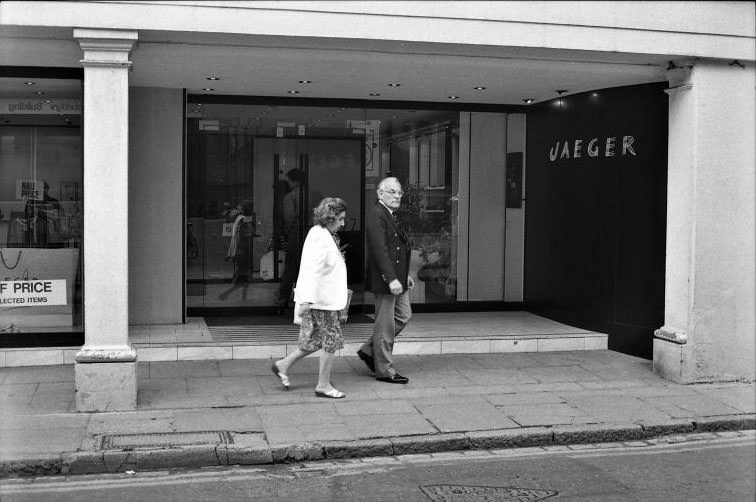
Along Bridge Street, a modern shopfront sits beneath a broad canopy supported by square columns, its recessed entrance catching the light and drawing the eye inward. The bold “JAEGER” lettering on the dark wall anchors the scene, while reflections in the glass hint at more stores and street life beyond the frame. Even without a precise date or place, the architecture and display style speak to a period when streamlined façades and polished glazing were becoming the language of city retail.
In the foreground, two pedestrians pass the doorway at an unhurried pace, their everyday clothes and steady stride giving the street a lived-in rhythm. The wide pavement, shallow steps, and clean lines of the entrance suggest a shopping district designed for foot traffic—browsing, meeting, and moving from one window to the next. Small details, like the curb edge and the layered reflections in the door, add texture to this Bridge Street moment.
For readers searching local history, this photograph offers a compact study of high-street commerce: branded signage, window displays, and the subtle choreography between storefront and passerby. The title “Bridge Street” pairs well with the theme of “Inventions,” because the scene quietly showcases innovations in retail design—deep-set entrances, covered walkways, and attention to visual merchandising. As a WordPress feature, it invites questions about how the street once looked, what businesses drew shoppers in, and how the experience of walking Bridge Street has changed over time.