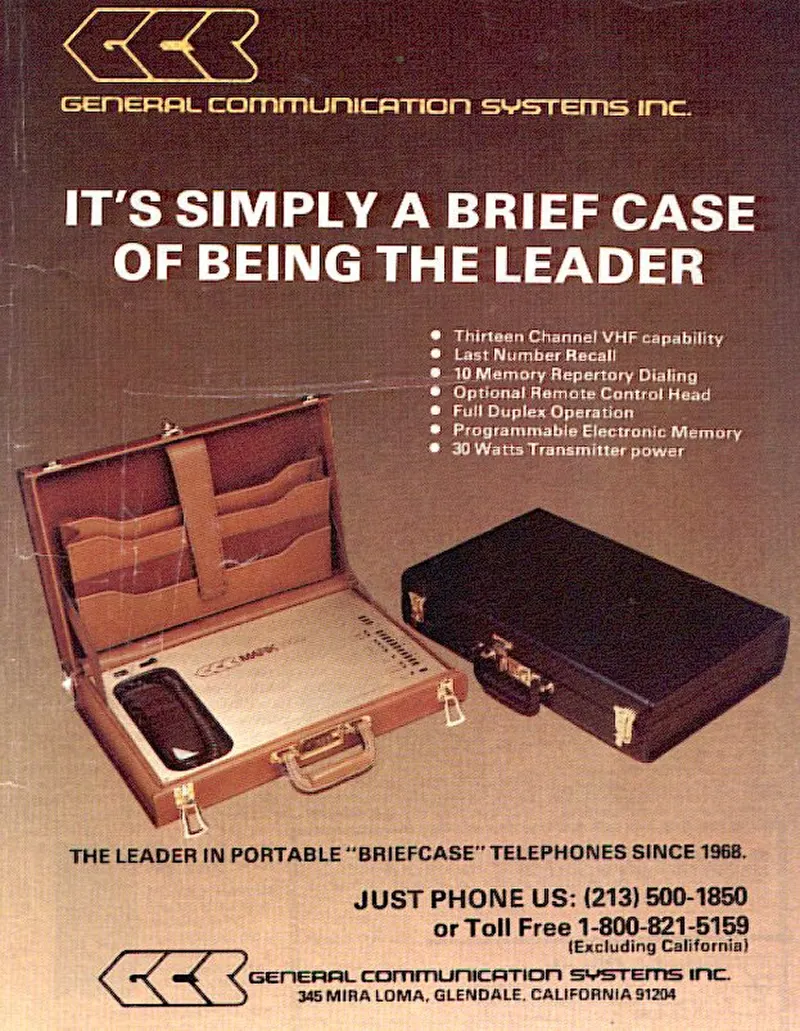
From the bold promise—“It’s simply a brief case of being the leader”—to the neatly staged equipment, this advertisement from General Communication Systems Inc. hints at an era when mobile calling was less a pocket-sized habit and more a piece of serious gear. An open briefcase reveals a built-in handset and electronics, while a second case sits beside it, selling portability in the language of business travel and executive convenience. Even before smartphones, the desire was the same: stay reachable, stay in control, and keep the conversation moving.
Details in the text read like a checklist of early mobile-phone ambition: “Thirteen Channel VHF capability,” “Last Number Recall,” “10 Memory Repertory Dialing,” “Full Duplex Operation,” and “30 Watts Transmitter power.” Those specifications point to car phone history’s transitional moment—when radio-based systems and rugged hardware were being packaged for everyday use, not just specialized fleets. The briefcase design also underscores the physical reality of the technology: mobility meant carrying the system with you, not slipping it into a jacket pocket.
Set within the broader story of car phones from the 1940s to 1980s inventions, this image captures the marketing mindset that helped normalize on-the-road communication. It’s a reminder that “portable” once meant latches, cables, and cases, backed by the confidence of a company claiming leadership “since 1968.” For readers exploring the evolution of mobile technology, this photo adds texture to the timeline—showing how the car phone moved from novelty to status symbol to stepping-stone toward the truly personal mobile devices that followed.