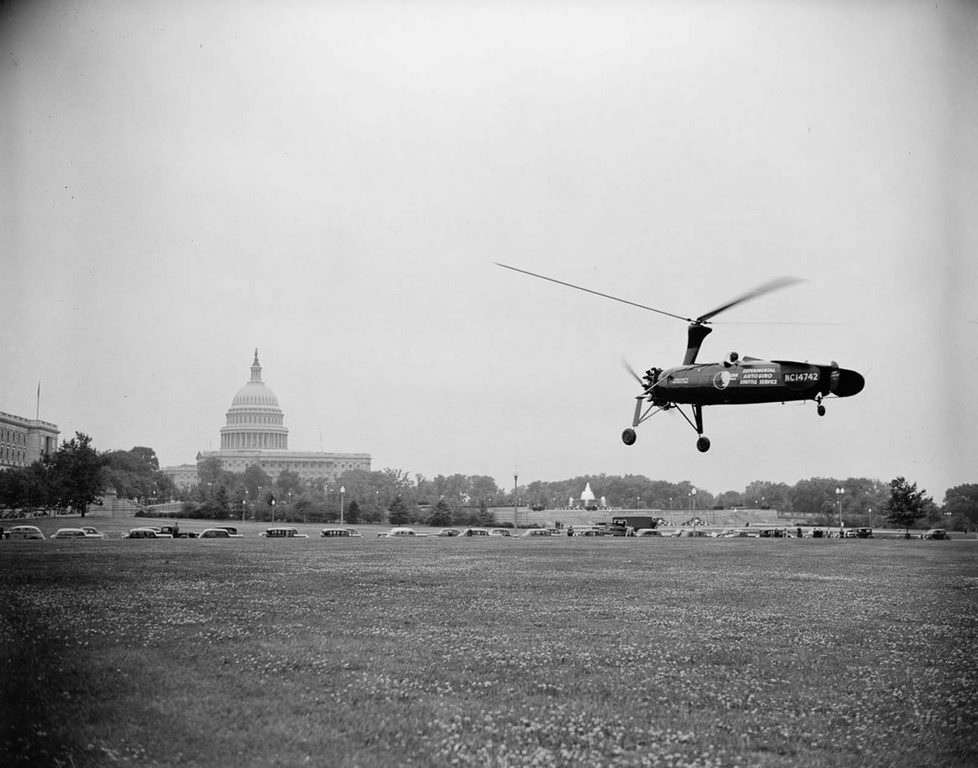
Against the open sky of Washington, D.C., an autogyro dips low over a broad field, its rotor a blurred circle that hints at motion and experiment. The U.S. Capitol rises in the distance while cars line the roadway, grounding the scene in everyday city life even as aviation pushes into new territory. On the aircraft’s side, “Autogiro” lettering and a tail number are visible, small details that make the demonstration feel official rather than fanciful.
Mail delivery had already learned to fly by the 1930s, yet the promise of the autogyro was different: short landings, tight spaces, and the possibility of bringing air service closer to the places where letters and parcels actually moved. In this 1938 moment, the grounds of a Washington post office became a makeshift proving ground—part publicity, part practical test—suggesting a future where postal aviation might not need long runways to be useful. The autogyro, halfway between airplane and helicopter in the public imagination, embodied that era’s hunger for faster connections.
Looking closely, the photograph reads like a snapshot of innovation meeting bureaucracy, with civic landmarks and neatly kept lawns framing a machine designed to shrink distance. For readers interested in early aviation history, autogyro technology, and the evolution of airmail in the United States, the image offers a vivid reminder that “the future” was often demonstrated in plain view. It’s an inventions story told in grass, asphalt, and spinning blades—an experiment staged at the heart of the capital to sell the idea that tomorrow’s mail could arrive from above.