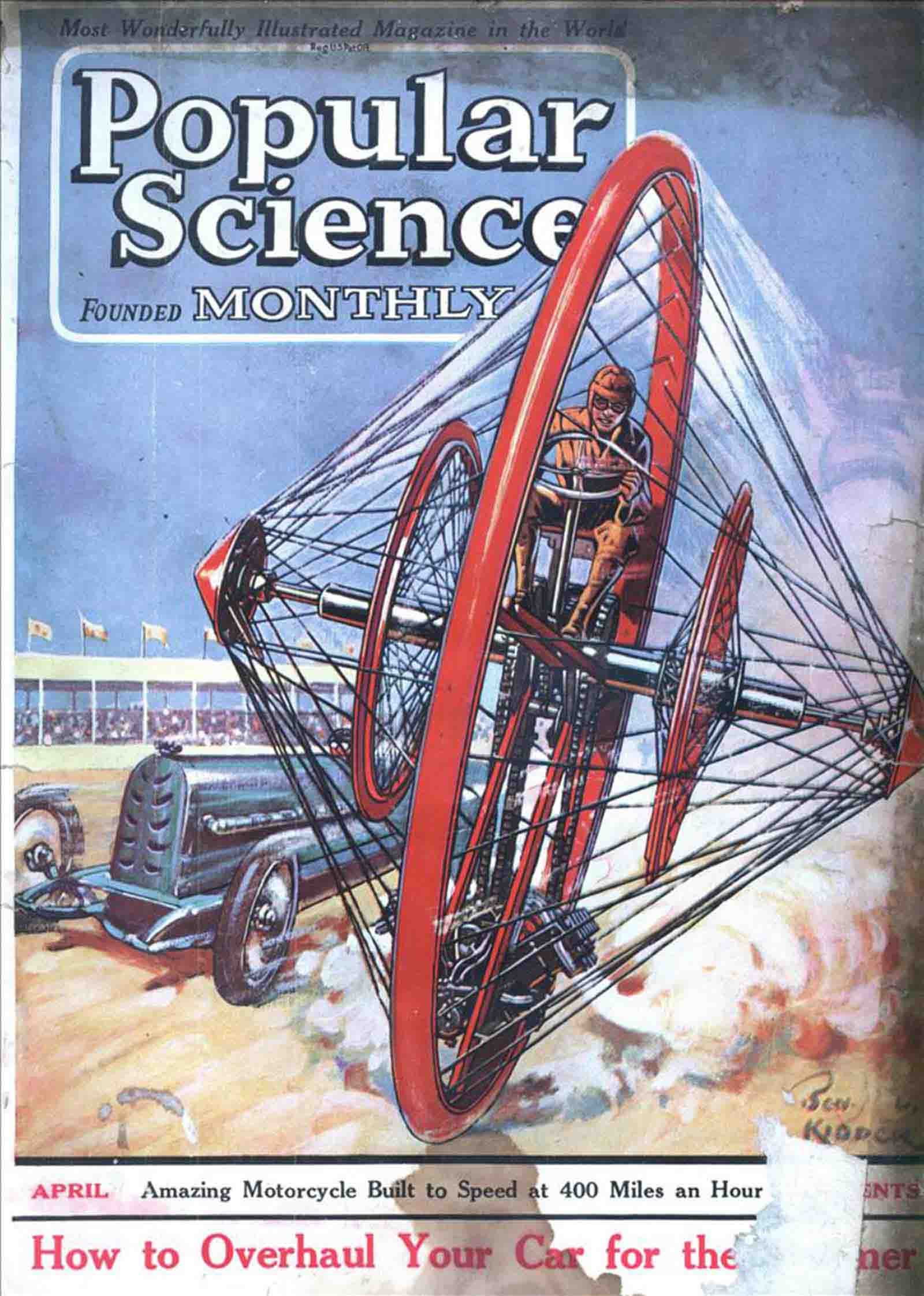
Popular Science once sold the future with bold cover art, and few concepts looked more daring than the monowheel. Here a rider sits inside a giant spoked ring, with the drivetrain and cockpit suspended in the center like a human gyroscope, while dust and smoke suggest speed and spectacle. The cover line even teases an “Amazing Motorcycle Built to Speed at 400 Miles an Hour,” a promise that captures the era’s appetite for extreme engineering claims.
A strange elegance runs through the design: one enormous wheel to reduce rolling resistance, minimal bodywork, and a cage-like structure meant to keep the operator upright as the rim spins around them. Yet the very thing that makes a monowheel unforgettable—putting the driver inside the rotating mass—also hints at its problems, from balance and braking to the terrifying possibility of the wheel “walking” ahead while the rider lags behind. In the background, a streamlined car and grandstand crowd frame the machine as a fairground marvel as much as a practical vehicle.
Collectors and history fans love images like this because they reveal how invention often moved forward through wild detours. Monowheels sit at the crossroads of motorcycle history, early popular mechanics culture, and the showmanship of speed trials, where publicity could be as important as performance. If you’re browsing bizarre vehicle inventions, this historical Popular Science illustration is a perfect doorway into the facts, the hype, and the hard physics that shaped the monowheel dream.