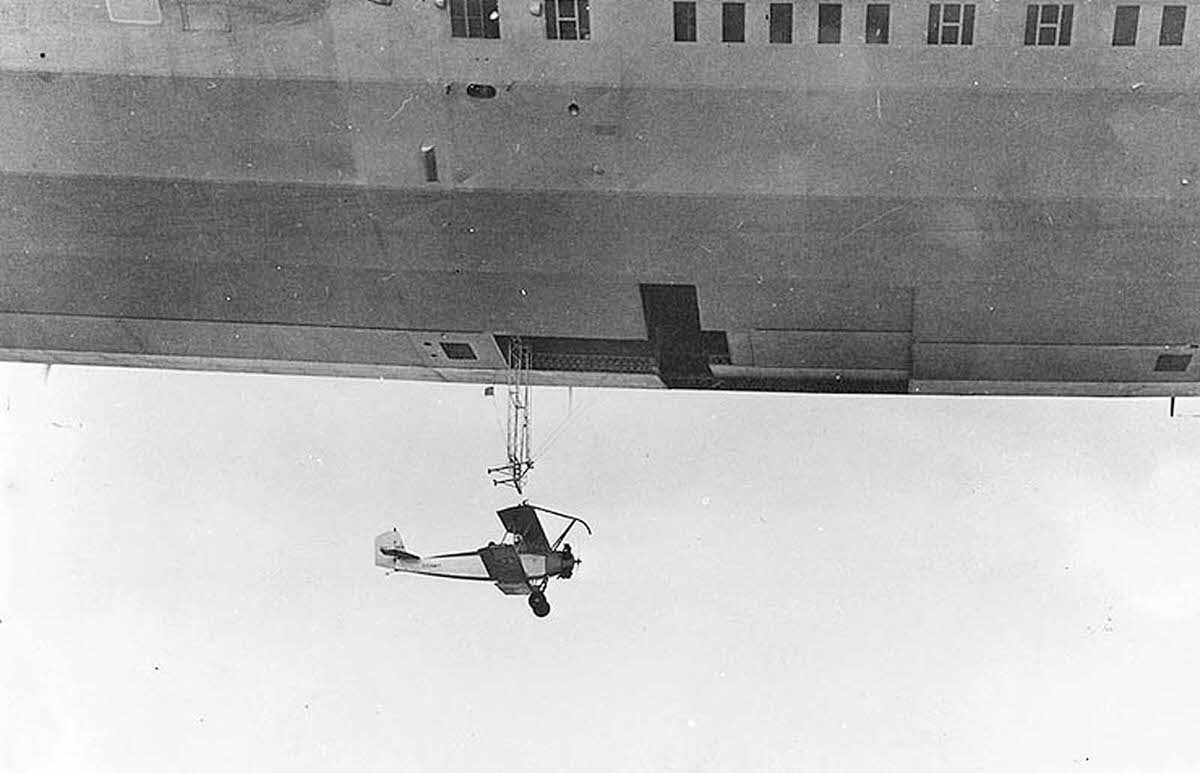
Beneath the broad belly of the USS Akron, a small Consolidated N2Y-1 training plane hangs in a moment that feels both precarious and meticulously planned. The airship’s massive hull dominates the frame, its windows and panel lines turning the sky into a kind of floating hangar deck, while the tiny biplane below provides an instant sense of scale. Captured during flight tests near Naval Air Station Lakehurst, New Jersey, on May 4, 1932, the photograph freezes an experiment that pushed the boundaries of what naval aviation could be.
Suspended from the Akron’s undercarriage, the N2Y-1 appears poised between worlds—neither fully independent nor fully secured—illustrating the “invention” at the heart of the scene: the idea that a dirigible could function as an airborne aircraft carrier. The visible trapeze-like apparatus hints at the specialized equipment required to launch and recover fixed-wing aircraft in midair, a technical challenge that demanded steady hands, precise timing, and confidence in engineering that was still being proven. Even in stark black and white, the image conveys motion and risk: the open air below, the looming airship above, and a plane ready to drop away into flight.
For readers drawn to U.S. Navy history, early flight testing, or the interwar era’s bold aviation concepts, this snapshot offers a vivid entry point into a largely forgotten chapter of innovation. Lakehurst’s association with lighter-than-air operations adds another layer of context, anchoring the Akron’s trials within a landscape built for experimentation at scale. As a historical photo, it’s both a dramatic visual and a reminder that progress often comes from audacious hybrids—part airship, part aircraft carrier, and entirely a product of its time.