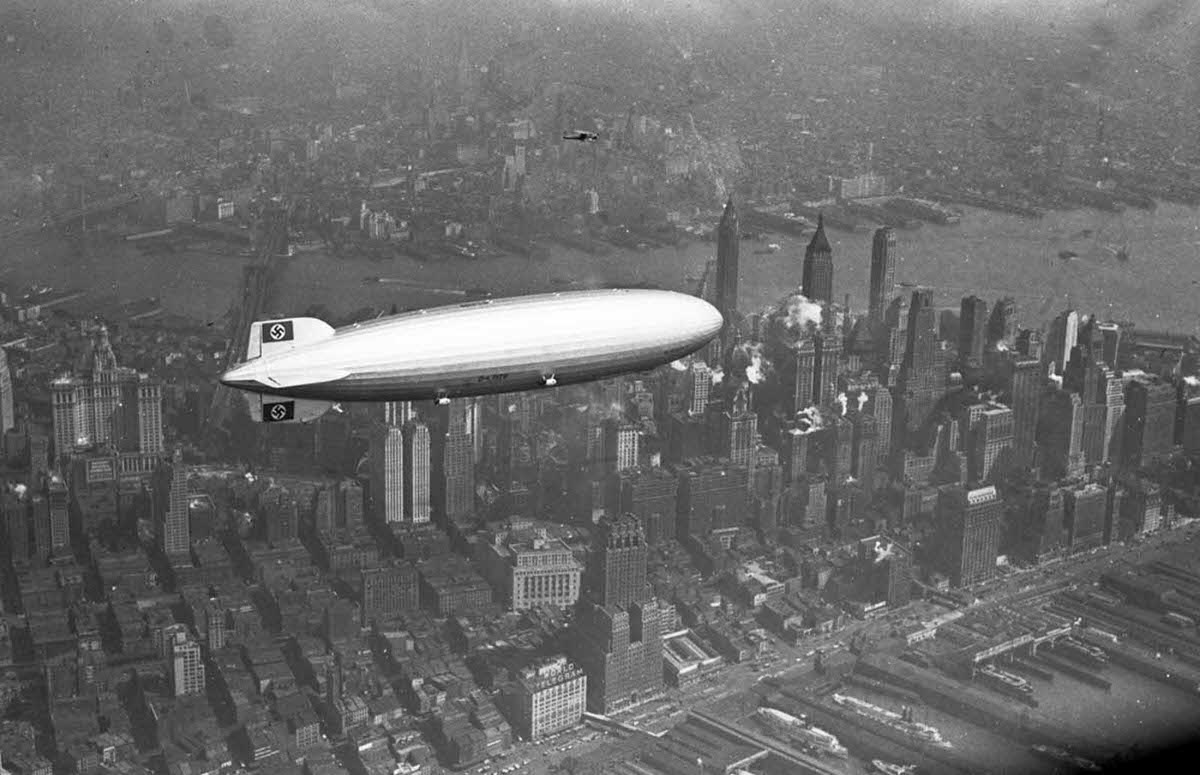
High above Manhattan’s tight grid of streets and rooftops, the German airship Hindenburg drifts like a polished, floating monument, dwarfing the skyscrapers beneath it. Smoke curls from building stacks and vents, giving the scene a gritty, lived-in texture that contrasts with the zeppelin’s smooth, streamlined body. The viewpoint turns the city into a sprawling pattern of blocks and towers, while the airship becomes the unmistakable focal point, suspended over the skyline on May 6, 1937.
Few inventions of the early 20th century promised modern travel quite like the great rigid airships, and this photograph captures that brief moment when the future seemed to arrive quietly from above. The Hindenburg’s presence over New York speaks to an era fascinated by scale—taller buildings, longer routes, faster connections—and to the confidence that engineering could tame distance. Details on the tail mark it as a product of its time, linking technological spectacle with the politics and propaganda that often traveled alongside it.
Seen today, the image reads as both an advertisement for progress and a poignant threshold, taken on the date that would soon become inseparable from the Hindenburg’s story. For readers searching the history of the Hindenburg, Manhattan, and 1937 aviation, this view offers a rare sense of how the airship era intersected with the world’s most vertical city. It’s a reminder that breakthroughs can feel serene in the moment—gliding above the skyline—before history gives them their sharper, lasting meaning.