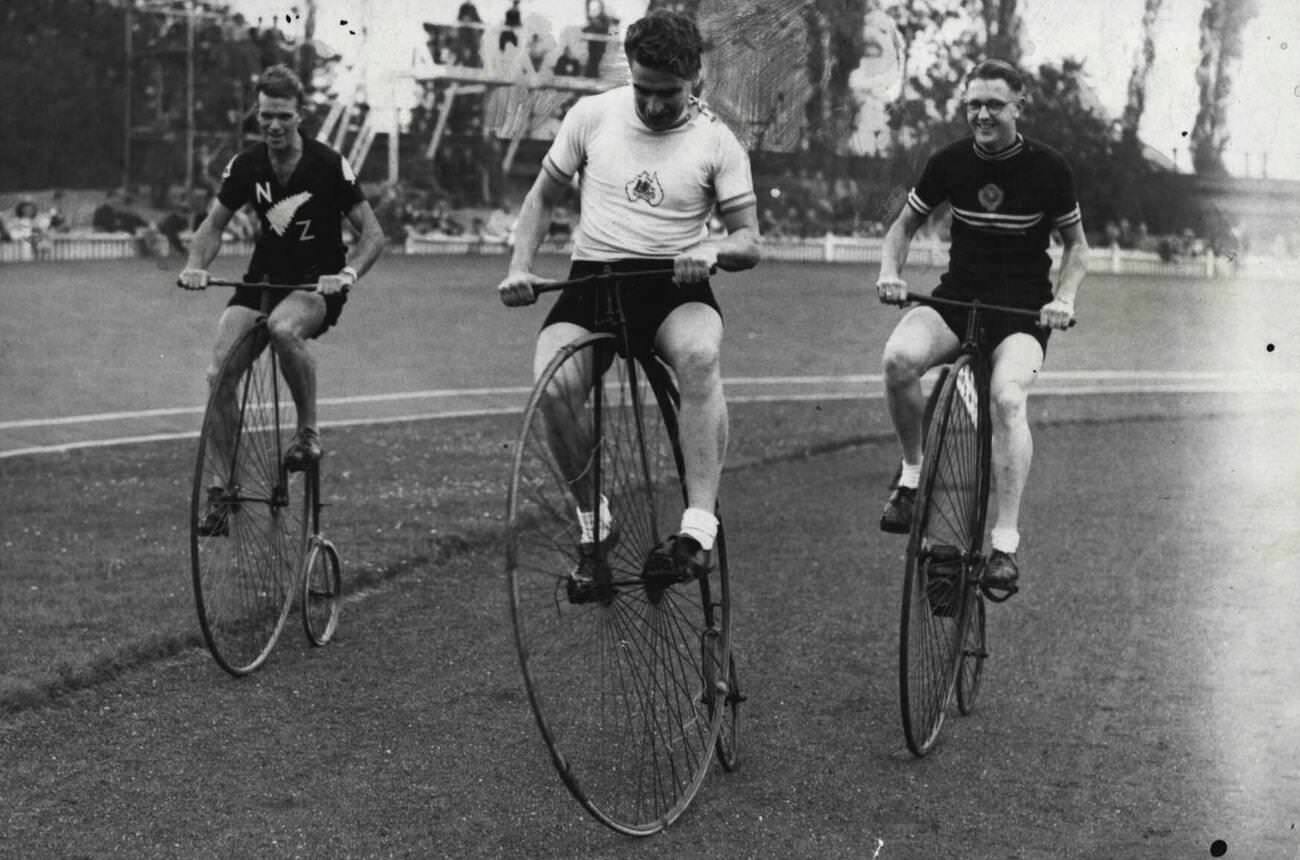
Across a track field bordered by spectators and trees, three cyclists balance high on penny-farthings, their oversized front wheels slicing a clean arc through the frame. The riders wear simple athletic kits—one with bold “N Z” lettering—and their relaxed faces suggest a demonstration or friendly competition rather than a grim endurance trial. It’s a lively glimpse of early cycling culture, when skill and nerve mattered as much as speed.
Penny-farthing design was an invention born from direct-drive mechanics: the bigger the front wheel, the farther you traveled per pedal turn. That engineering choice delivered swift motion on smoother surfaces, but it also demanded careful mounting, steady posture, and quick reflexes when the wheel met uneven ground. In photographs like this, the long spokes, thin tires, and minimalist frames reveal a transitional moment in bicycle history, poised between daring novelty and everyday sport.
Meanwhile, the image speaks to the social side of vintage cycling photographs—uniforms, club identity, and public spaces turned into arenas for modern recreation. For readers searching the history of the penny-farthing era, this scene captures the blend of invention and performance that made early bicycles such a sensation. As a timeless archival snapshot, it invites a closer look at how engineering experiments rolled into popular spectacle and helped shape the bicycle as we know it.