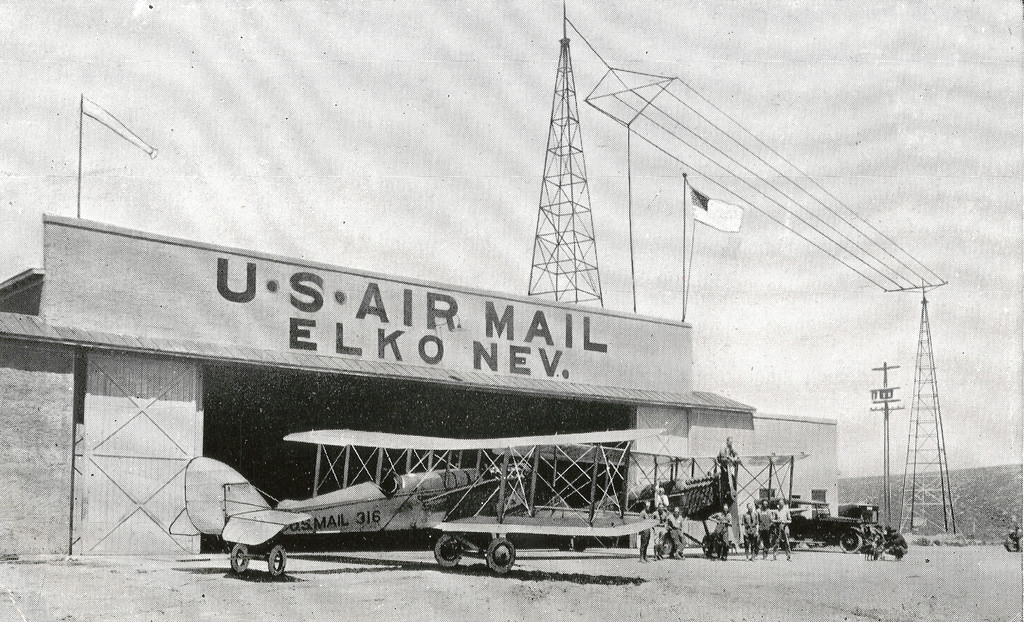
Bold lettering across a low hangar announces “U.S. AIR MAIL, ELKO NEV.,” turning an unassuming airfield into a crossroads of modern communication. In front of the open doors sits a biplane marked “AIRMAIL 316,” its latticework wings and spoked wheels a reminder of how lightweight wood-and-fabric craft carried outsized ambitions. A small group gathers near the nose, suggesting the bustle that accompanied each arrival and departure on America’s early airmail routes.
Elko’s role in 1920 airmail service comes through in the supporting cast of equipment: tall radio masts, stretched antenna wires, and utility poles rising behind the building. Those structures hint at the early infrastructure that made scheduled flights possible—navigation aids, communications, and the practical systems that stitched remote stretches of Nevada into a national network. Even the windsock at the edge of the roofline signals a field learning to read the sky like a timetable.
Set against open space and distant hills, the scene captures the experimental confidence of the era’s aviation “inventions,” when reliability was engineered one flight at a time. For readers interested in U.S. Air Mail history, early aviation in Nevada, or the story of biplanes serving the American West, this photograph offers a grounded view of progress: a hangar, a handful of workers, and a machine designed to outrun geography. It’s a snapshot of how mail, technology, and community intersected at Elko long before airports became anonymous terminals.