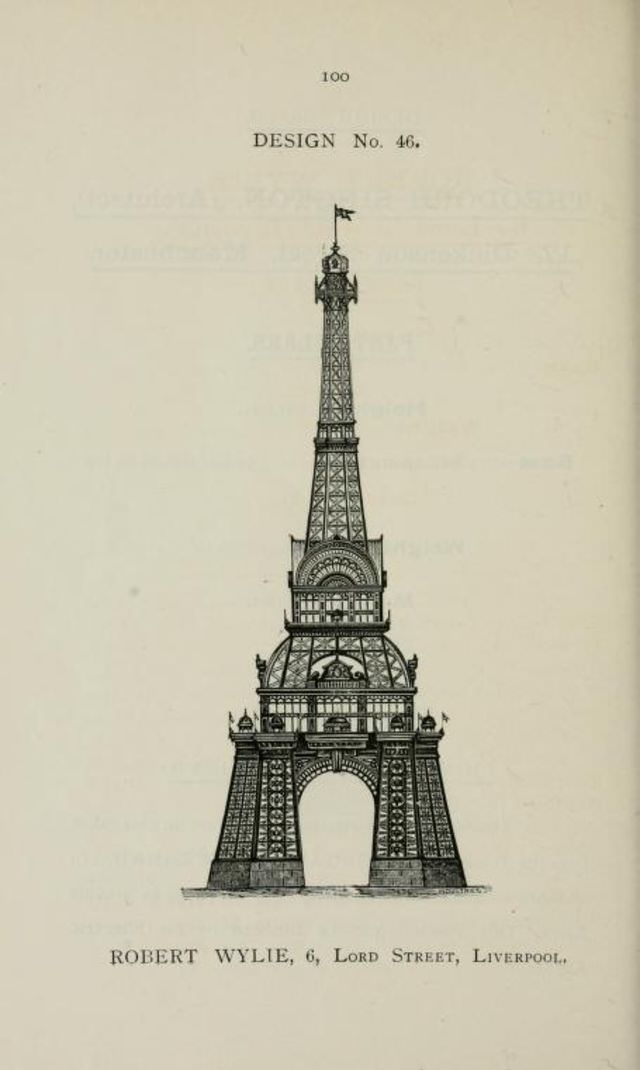
Page 100 introduces “DESIGN No. 46,” one of the many competitive proposals submitted for the construction of a “Great Tower for London” in the 1890 era of inventions and ambitious engineering. Rendered like a catalogue plate, the elevation is crisp and symmetrical, presenting an iron-lattice shaft rising from an ornate, masonry-like base with a grand central archway. A small flag crowns the pinnacle, while layered galleries and decorative bands suggest viewing platforms, civic pride, and a desire to rival the most celebrated towers of the age.
What stands out is the blend of practicality and spectacle: the structure reads as both monument and destination, with its massive gateway promising circulation at street level and its stacked stages hinting at interiors, lifts, or observation rooms. The heavy lower piers transition into a lighter trussed framework above, a classic late-19th-century visual argument for modern materials tempered by familiar architectural ornament. Even in a single drawing, the design communicates the era’s fascination with height, tourism, and the public theater of technology.
At the bottom, the attribution “ROBERT WYLIE, 6, LORD STREET, LIVERPOOL” grounds the concept in the broader British design network that fed London’s competitions and exhibitions. Posts like this help trace how Victorian Britain imagined its skyline—through dozens of alternative Great Tower schemes that ranged from boldly industrial to richly decorative. For readers searching “Great Tower for London 1890 designs” or “Victorian invention tower proposals,” this image offers a compelling glimpse into the competitive creativity behind an unrealized landmark.