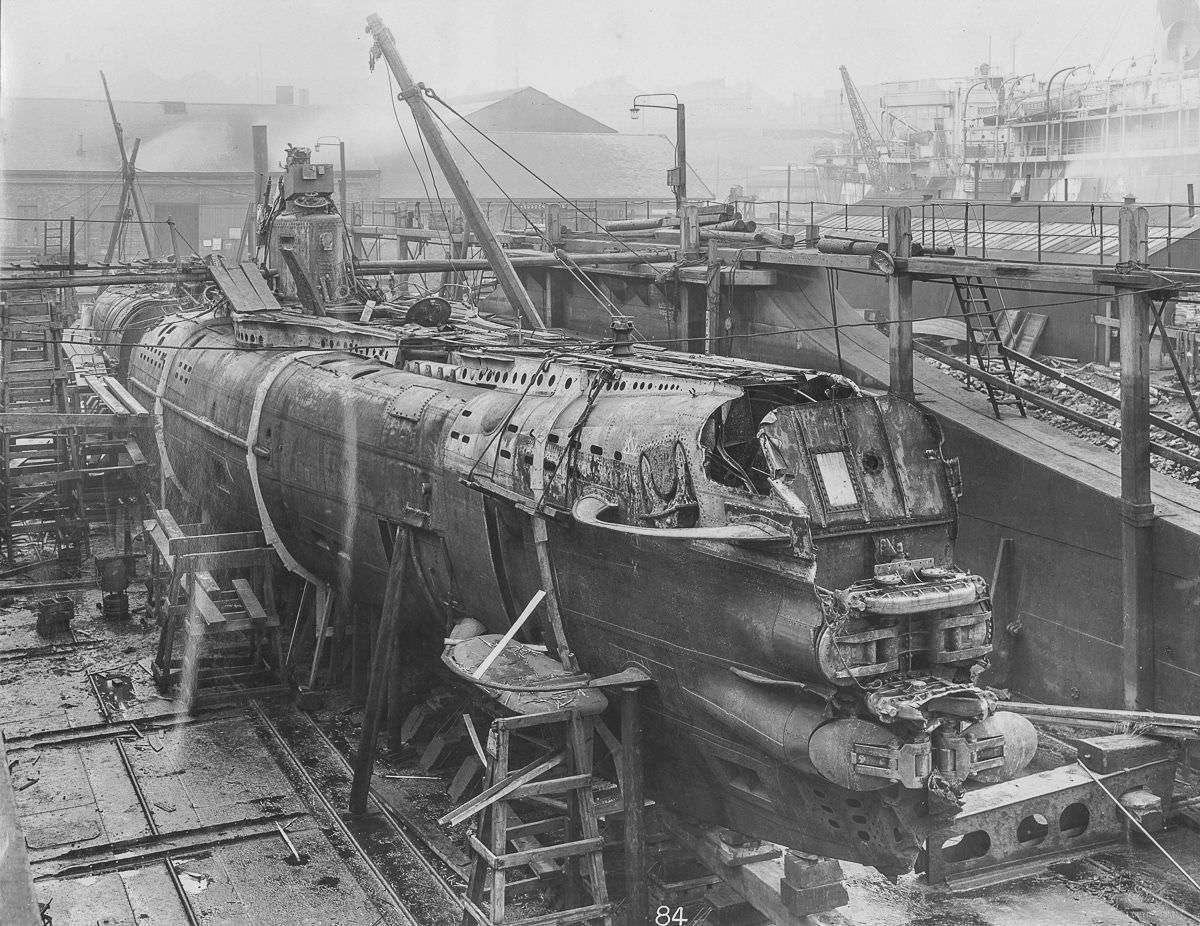
Steel ribs and dented plating dominate the frame as U-Boat 110 sits hauled into a dockyard cradle, stripped of mystery and exposed to daylight. The conning tower rises like a stubby watchpost above the hull, while cranes, scaffolding, and narrow walkways crowd in close, turning the scene into an industrial amphitheater. The battered bow and open fittings hint at a vessel interrupted mid-story, its hard-used surfaces speaking of saltwater pressure, collision, and hurried repairs.
Look closely and the photograph becomes a catalog of early submarine engineering: riveted seams, access panels, vent holes, and the blunt geometry of a war-built machine designed for stealth rather than comfort. The torpedo-end silhouette and the heavy hardware at the front suggest the practical, mechanical logic of undersea warfare, where every protrusion had a purpose and every compartment was a compromise. Even without naming a port or crew, the image invites a rare kind of “journey” inside 1918-era inventions—one made through metalwork, weld lines, and the scars left by use.
Behind the U-boat, the hazy background of ships and dock structures situates this moment in a busy maritime world, where captured technology and improvised analysis often shared the same slipways as routine maintenance. For readers drawn to World War I history, naval archaeology, and the evolution of submarine design, this is an SEO-worthy glimpse into U-Boat 110 as an object of fascination as much as conflict. The ghostly underwater lair becomes strangely tangible here: not in open sea, but in a workshop of timber supports and iron gantries where secrets could be measured, photographed, and remembered.