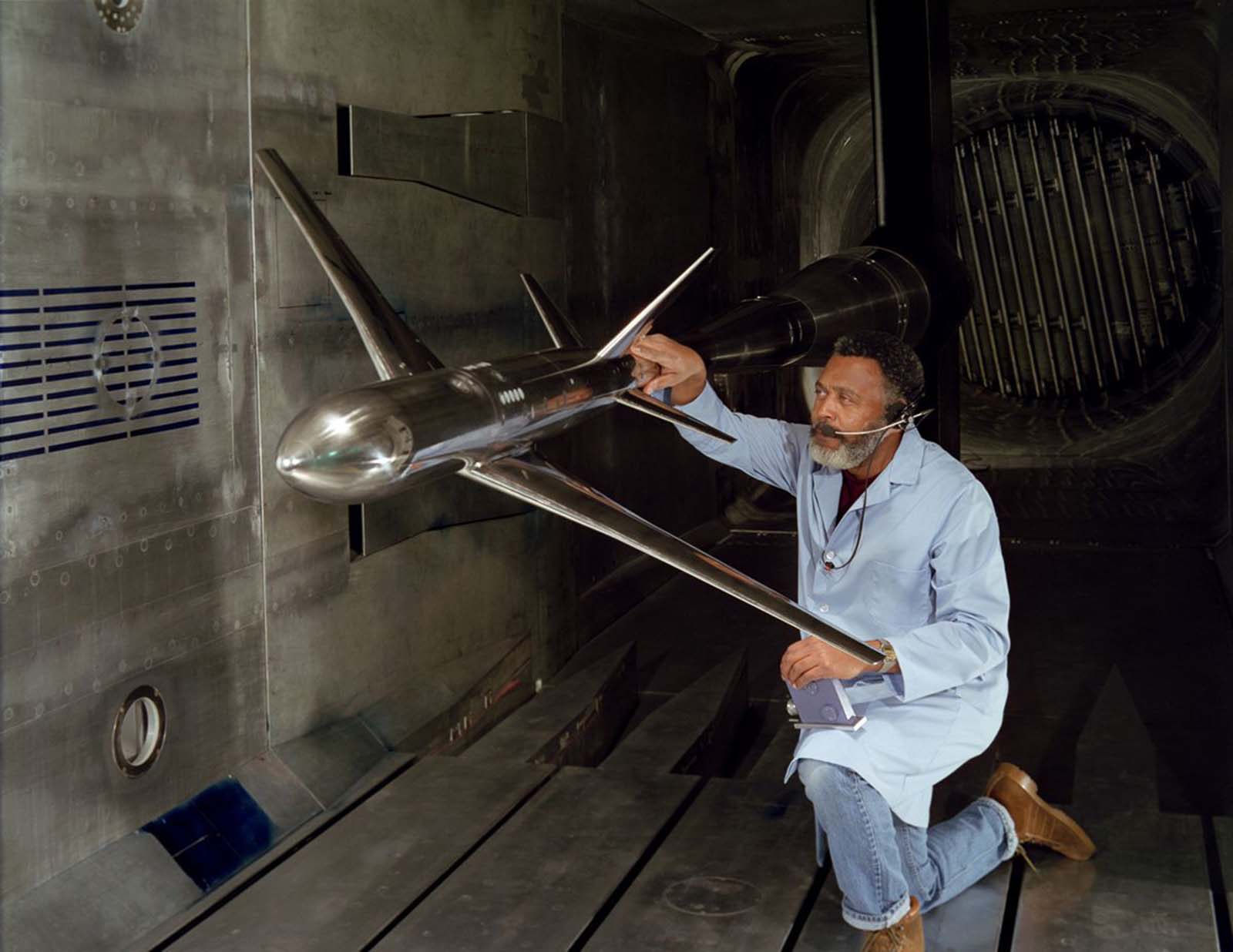
Inside the cavernous throat of Langley’s National Transonic Facility, a polished transport model named Pathfinder I hangs in readiness while NASA technician W.L. Jones pauses between test runs to give it a careful inspection. The aircraft’s sleek nose and long, thin wings catch the light against the dark, industrial tunnel walls, emphasizing how much aerodynamic research depends on precise surfaces and exact alignments. Even in stillness, the scene hints at the controlled power of wind tunnel testing, where air can be made to behave like flight at speed.
Jones, wearing a headset and a lab coat, reaches up to check the model with the focused, practiced attention that keeps experiments honest. The setup around him—mounting hardware, access panels, and the massive test-section geometry—speaks to the engineered environment behind aerospace breakthroughs, where a single run can produce data that reshapes design decisions. Details like these make the photo an evocative snapshot of 1980s NASA research culture: hands-on, methodical, and relentlessly iterative.
For readers interested in aviation history and the evolution of flight technology, this 1986 moment offers more than a behind-the-scenes look—it underscores the craft of translating ideas into measurable performance. Wind tunnel work at facilities like Langley’s NTF helped refine the understanding of how transport aircraft behave in challenging transonic conditions, bridging the gap between theory and real-world airframes. The result is a compelling historical image for anyone exploring NASA innovation, aerodynamics, and the human expertise that quietly powers major advances.