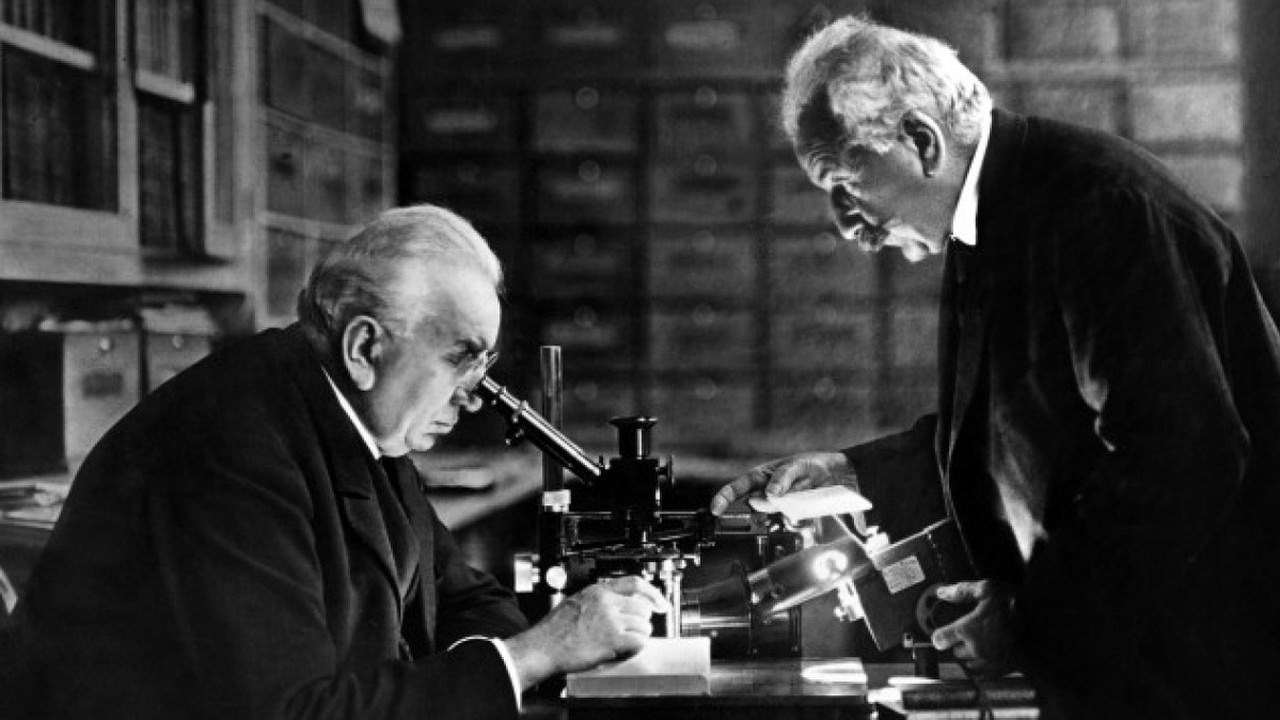
In a dim, workshop-like interior lined with drawers and shelves, two formally dressed men lean over a compact mechanical apparatus, their attention fixed on its optics and moving parts. One peers closely through a viewing tube while the other hovers beside a small light source, as if checking alignment or exposure. The scene carries the quiet intensity of experimentation, where precision and patience matter as much as inspiration.
The post title points to the Cinématographe camera (1895) associated with Auguste and Louis Lumière, a name that sits at the foundation of early motion picture technology. Here, the instrument on the table reads as more than a camera: it suggests a practical machine meant to handle image capture with careful control, bridging the gap between laboratory tinkering and public demonstration. Details like the sturdy base, the clustered components, and the close handwork evoke the era when cinema was still an invention being refined, not yet an industry.
For readers interested in film history and classic inventions, this photograph offers an evocative window into the hands-on craft behind the first moving images. It complements searches for Cinématographe, Lumière brothers, early cinema equipment, and the origins of filmmaking by illustrating the human scale of the breakthrough—men bent over metal, glass, and light in pursuit of motion on a screen. The atmosphere is both technical and theatrical, hinting at how a small device in a workroom could soon reshape popular culture worldwide.