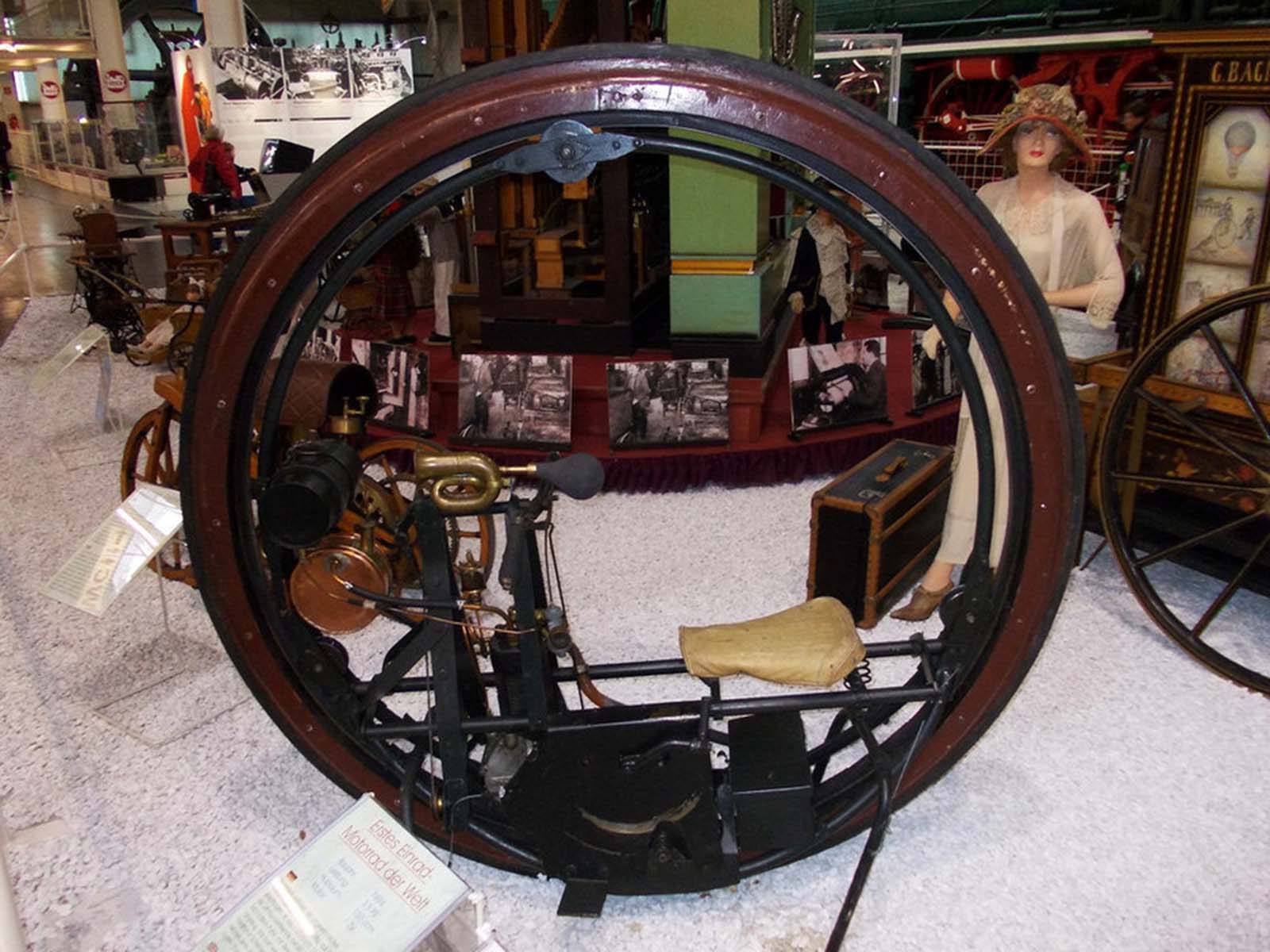
A single, towering wheel dominates the museum floor at the Technik Museum Sinsheim, its dark rim and exposed framework forming a circle that feels part bicycle, part industrial experiment. The Edison-Puton monowheel is displayed so visitors can study the practical details: a small saddle perched within the ring, slender struts, and compact mechanical components clustered near the rider’s position. Even at rest, the machine suggests motion, inviting the imagination to picture how balance, steering, and propulsion might have worked in such an unusual one-wheel vehicle.
Seen up close, the monowheel reads like a chapter from the early history of transportation—an era when inventors tested bold alternatives to the familiar two-wheeled bicycle and emerging motor vehicles. The design places the rider inside the wheel rather than above it, a choice that highlights both ingenuity and risk, as stability would have been a constant negotiation between body and machine. Around the exhibit, period photographs and neighboring artifacts reinforce the broader theme of inventions: progress made not only through successes, but also through daring prototypes that challenged common sense.
For anyone searching for “Edison-Puton monowheel,” “monowheel invention,” or “Technik Museum Sinsheim Germany,” this display offers a striking visual reference point and a reminder of how experimental mobility once looked. Museum lighting and the surrounding gallery context emphasize materials, workmanship, and the careful preservation of mechanical curiosities that might otherwise be forgotten. The result is a memorable historical photo subject—an eccentric, elegant wheel that captures the restless creativity of early engineering.