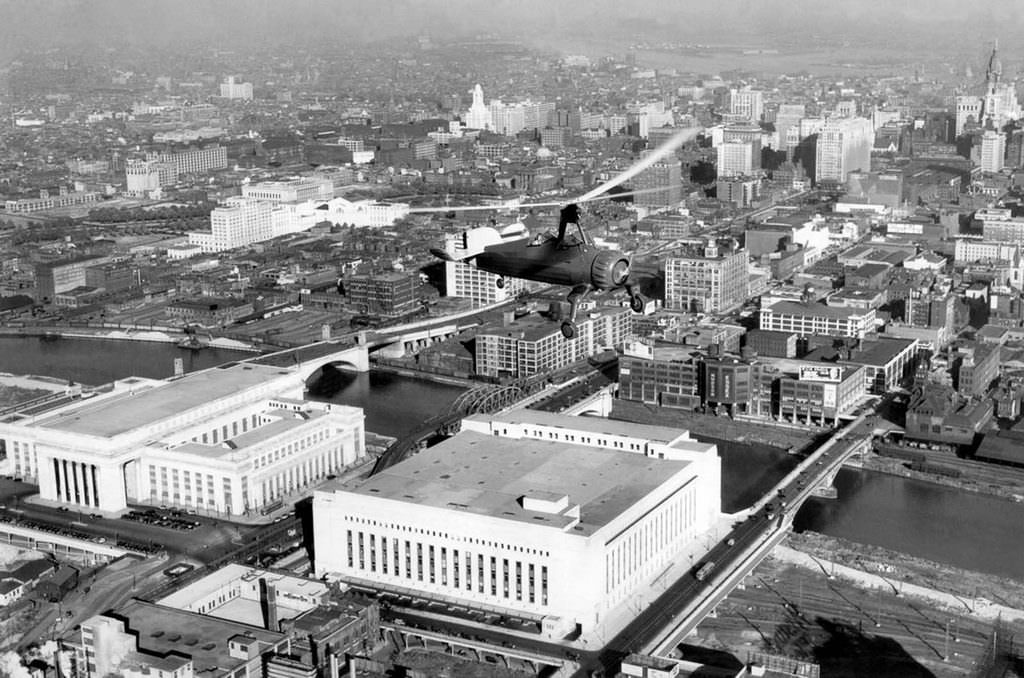
Over the dense grid of Philadelphia in 1930, an autogyro threads the sky like a mechanical dragonfly, its rotor a pale blur against the haze. Below, broad civic buildings and tightly packed blocks spread to the river, where bridges stitch one shore to the other and the city’s industrial spine is clearly visible from above. The perspective feels modern—an aerial tour long before drones—yet the aircraft itself belongs to a brief, fascinating chapter of early aviation.
Unlike a conventional airplane, the autogyro relied on an unpowered rotor for lift and a propeller for forward thrust, promising slower, safer flight and shorter takeoffs than many aircraft of its day. That promise made it a headline-grabbing invention, the kind of machine that turned test flights and demonstrations into public events. In this photograph, the craft’s compact body and spindly landing gear stand out sharply against the patterned rooftops and waterways, emphasizing both its experimental character and the confidence of the era.
Seen today, the scene reads as a meeting point between city history and aeronautical innovation: Philadelphia’s evolving skyline under an aircraft designed to redefine how people moved through the air. The 1930 setting matters, too—an age when aviation was rapidly shifting from spectacle to infrastructure, and urban America watched the future arrive overhead. For readers interested in inventions, vintage aviation, or Philadelphia history, this image offers a vivid reminder of how quickly the sky became part of the city’s story.