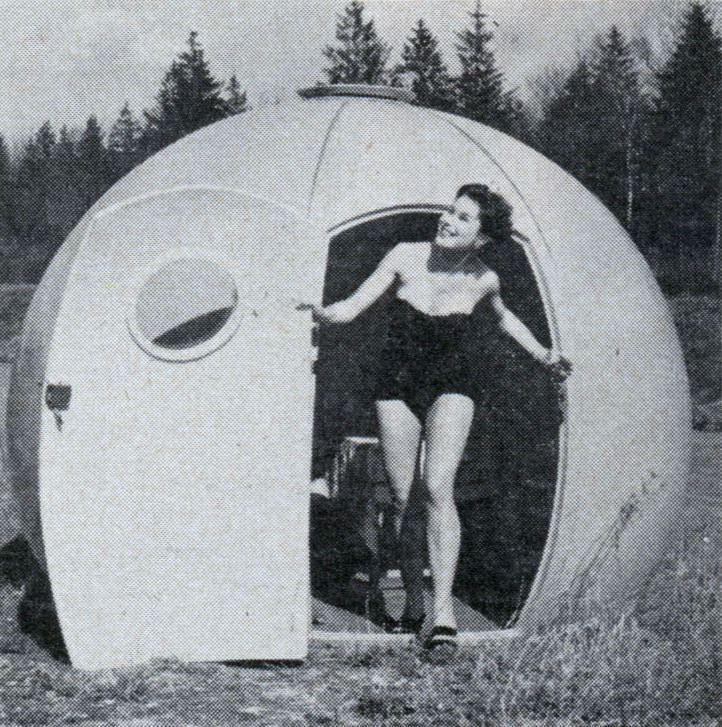
A rounded, pod-like shelter sits at the edge of a forest clearing, its smooth shell and porthole-style window giving it the look of a miniature cabin designed for the road. The open doorway reveals just enough of the interior to suggest a snug place to sleep or wait out bad weather, while a visitor posed at the entrance hints at the shelter’s human scale. As a piece of “Inventions” era optimism, it promises comfort with minimal fuss—an early answer to the question of how to house travelers quickly and efficiently.
Unlike a traditional tent, the structure appears rigid and weather-ready, with a single molded body that could be set down wherever campers and tourists needed a temporary home. The design language borrows from modern industrial forms—curved surfaces, simple openings, and a compact footprint—suggesting portability, easy cleaning, and the kind of durability that public campgrounds and roadside stops would have valued. Even without technical specs in view, the photo invites readers to imagine how such a shelter might be transported, anchored, and reused season after season.
Travel history is full of experiments that tried to make the outdoors more accessible, and this finished shelter fits neatly into that lineage of inventive camping solutions. It reflects a moment when leisure travel was increasingly popular and designers looked for standardized, prefabricated ways to offer privacy and protection without building permanent structures. For anyone interested in vintage camping gear, mid-century-style design, or the evolution of tourist accommodations, the scene is a compelling snapshot of practical innovation in a natural setting.