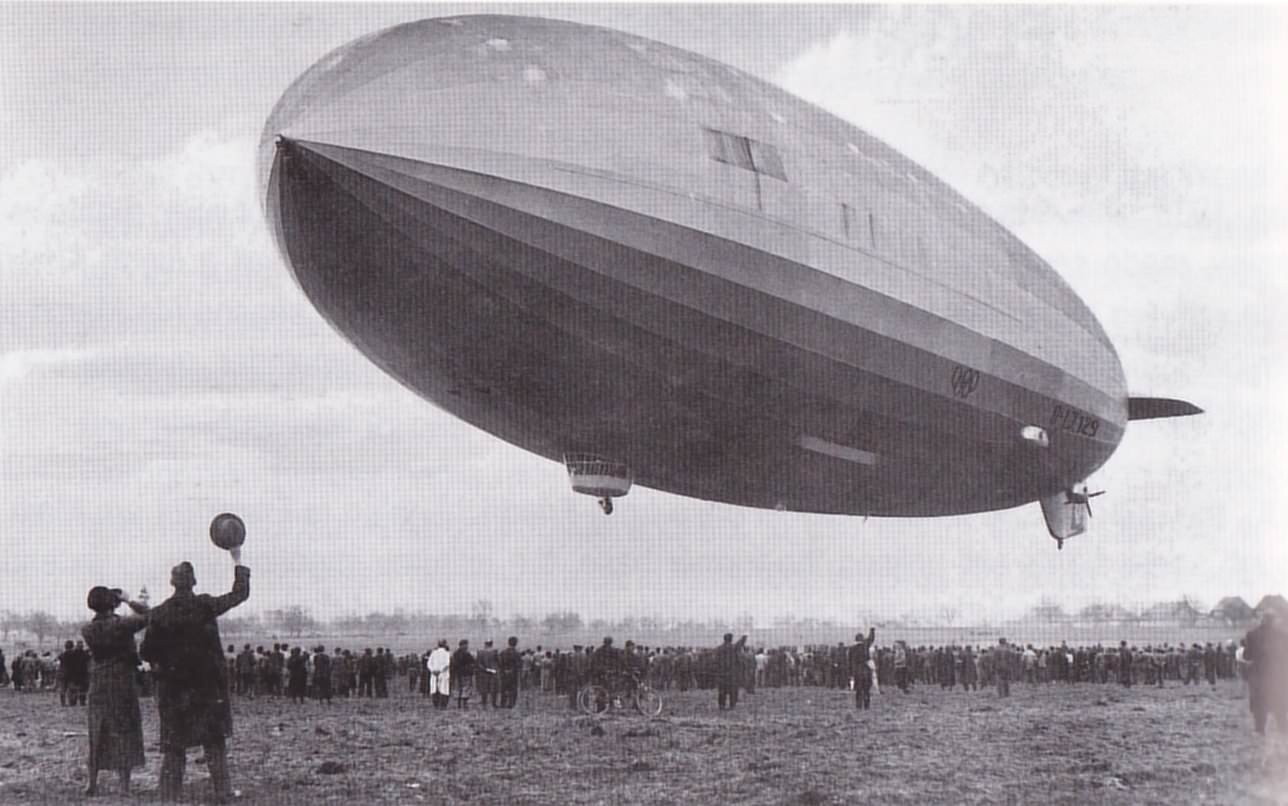
A vast silver hull hangs low over an open field, its rounded nose dominating the sky as spectators gather beneath it in a long, dark band. In the foreground, a couple of onlookers lift their arms in awe, a small human gesture against the immense scale of the airship. The title points to a defining moment: the LZ 129 rising into the air for the first time, when engineering ambition turned into motion.
Seen from below, the rigid airship’s smooth skin and crisp panel lines read like a blueprint made real, with a gondola and fin details visible along the underside and tail. The crowd’s distance emphasizes both caution and ceremony—an early flight was a public event as much as a technical trial. Even in a simple black-and-white frame, the contrast between the grounded landscape and the buoyant craft conveys the drama of lift and lighter-than-air design.
For readers interested in inventions and aviation history, this photograph captures the optimism surrounding interwar air travel and the promise of long-range passenger routes by zeppelin. It’s a powerful visual reminder of how airships were once imagined as the future of transportation—silent, monumental, and almost architectural in the way they occupied the air. As the LZ 129 rises, the scene preserves the brief instant when the crowd’s anticipation and the machine’s first ascent met in the same breath.