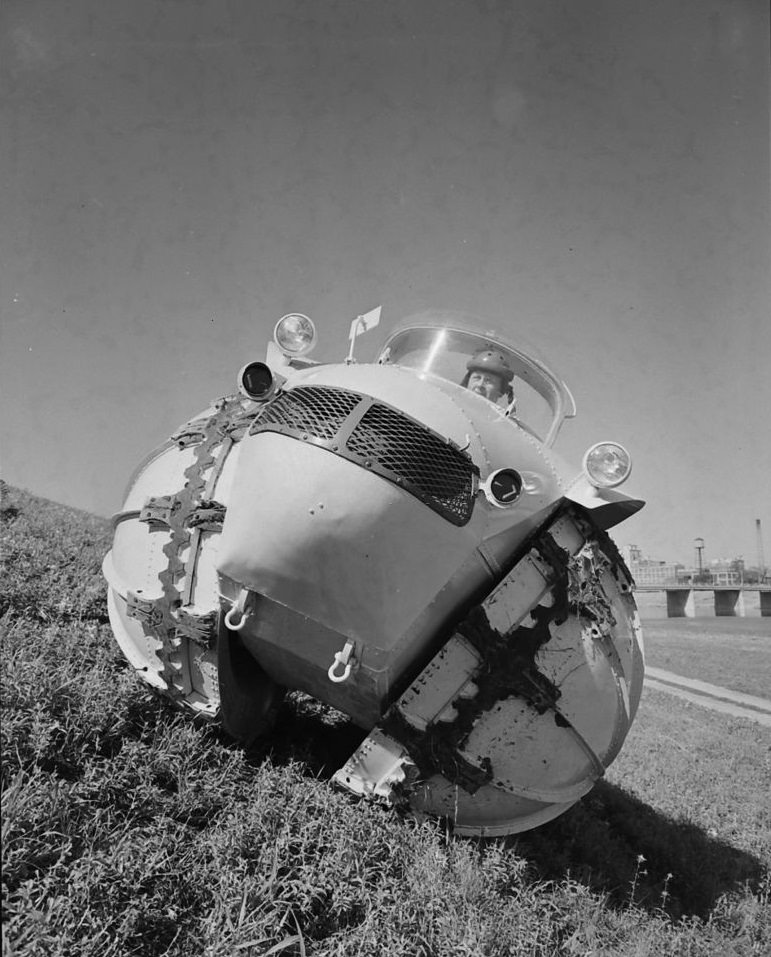
Rolling forward like something dreamt up in a workshop far from any paved road, the machine in this photo looks part automobile, part armored beetle. Instead of conventional tires, it rides on four enormous drum-like wheels studded with traction elements, giving the body a boat-hull silhouette meant to shrug off ruts, muskeg, snow, and loose ground. A driver sits high behind a curved windscreen, while a stout grille and clustered lamps suggest practicality over elegance—an invention built to keep moving when ordinary vehicles simply bog down.
The title’s promise of a four-wheel, five-ton patrol vehicle for Alaska and Canada points to a familiar northern challenge: distance plus terrain equals isolation. Engineers who tackled that problem often borrowed ideas from tanks, tractors, and amphibious craft, chasing flotation over softness and grip over slick surfaces. Those giant rolling drums hint at a strategy to spread weight and climb over obstacles, making the vehicle as much a terrain experiment as a tool for defense and frontier policing.
Seen today, this strange land cruiser feels like a missing chapter in the history of off-road technology, a predecessor to modern all-terrain vehicles and specialized Arctic transport. Its bulbous wheels and rugged fittings speak to a period when inventors tested bold solutions in full-scale metal, not just on paper, hoping to master the vast open spaces of the North. For readers searching vintage military engineering, early all-terrain vehicles, or Arctic patrol inventions, this photograph offers a compelling glimpse of how ingenuity tried to outmuscle geography.