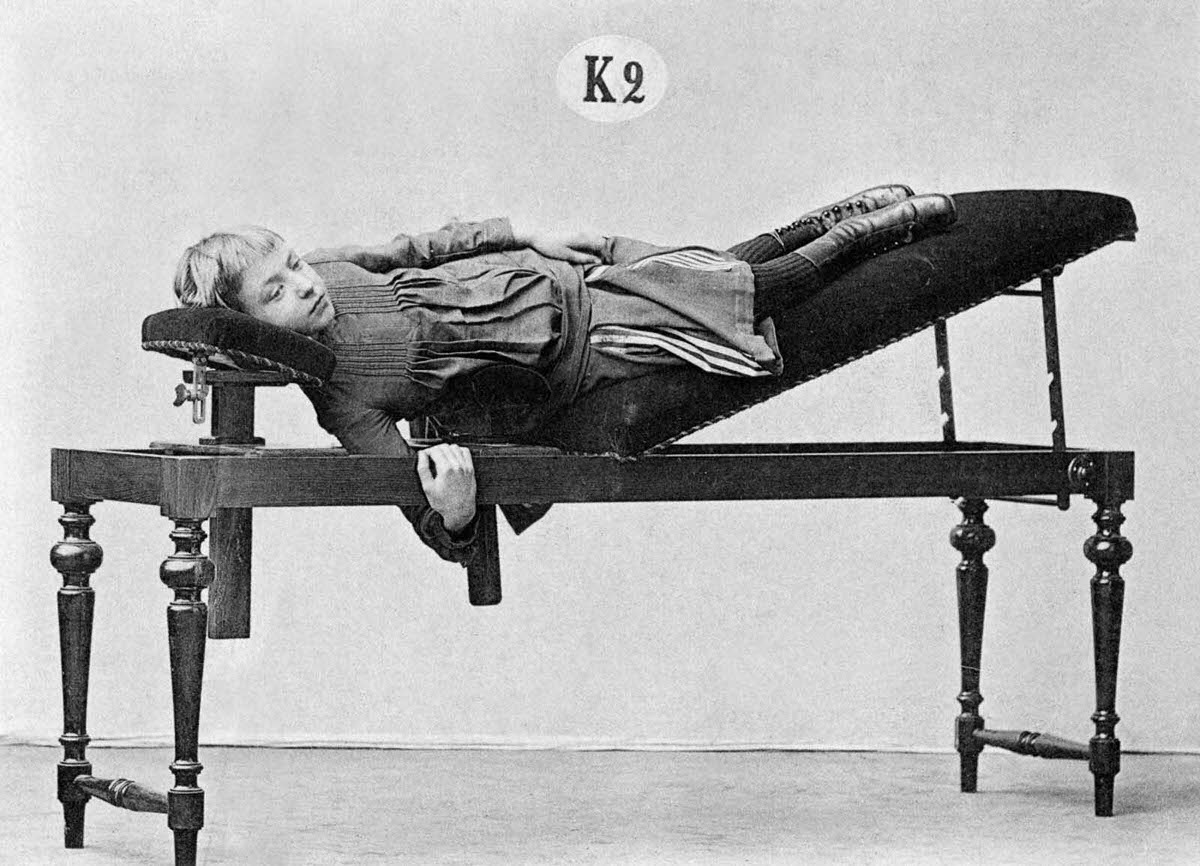
At first glance the apparatus could pass for a plush, velvet-topped dining table set on turned wooden legs, but the staged pose gives away its true purpose. A woman lies on her side across a long padded surface, with her head supported on a small adjustable rest and her body aligned along a slightly angled platform. Even the plain studio backdrop seems designed to keep all attention on the machine’s promise of bodily order.
Look closer and the “table” reveals the language of early therapeutic invention: hinges, clamps, and a shifting incline meant to guide the torso into a controlled side-press. One arm drops through an opening while the other steadies her on the edge, suggesting how leverage and positioning were central to the treatment. The overall design feels halfway between furniture and medical equipment—domestic in silhouette, clinical in intention.
Devices like this side-pressing apparatus speak to a period fascinated by mechanical solutions for posture, muscle balance, and joint alignment. The photograph’s careful demonstration doubles as advertising, translating complex ideas about the skeleton and soft tissue into a single, legible scene. For readers drawn to the history of inventions, physical culture, and vintage medical technology, it’s a striking reminder of how health trends were engineered—quite literally—into everyday-looking objects.