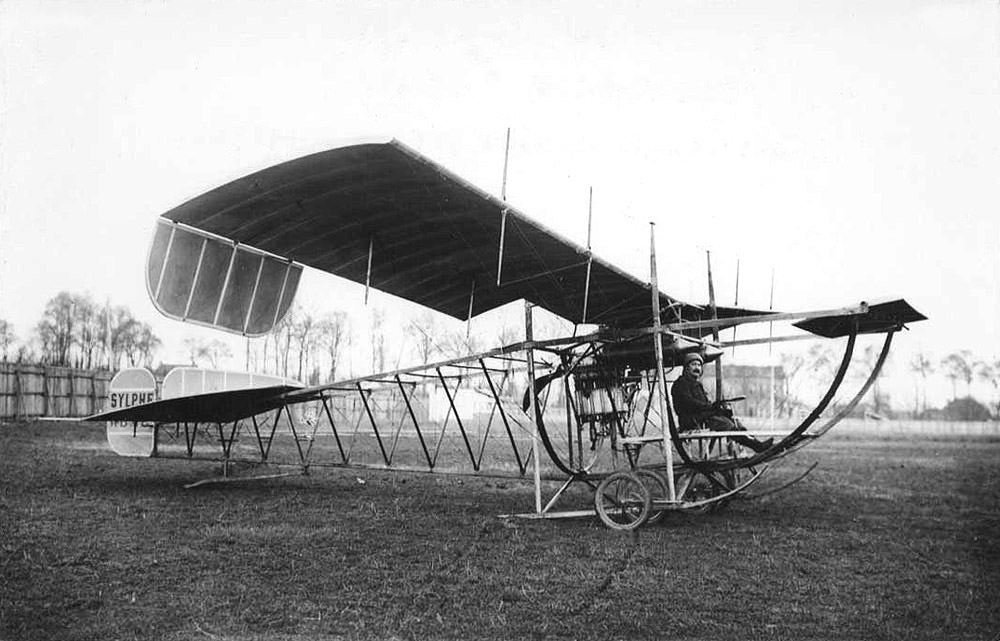
Sylphe 1911 evokes the restless optimism of early aviation, when flight still looked experimental and daring. The aircraft in the photo sits low on the grass, its long, lightly braced fuselage stretching back to a compact tail marked “SYLPHE,” while a broad wing canopy dominates the frame like a floating roof.
Up close, the construction reads like a lesson in invention: exposed struts and wires, a skeletal framework, and an open pilot’s position that leaves little between the aviator and the wind. A small wheelset and curved skids suggest the practical challenges of ground handling in an era before standardized landing gear, and the overall design hints at the trial-and-error engineering that pushed machines from workshop sketches into the sky.
For readers interested in inventions and the history of flight, this historical photo offers more than a single aircraft portrait—it preserves a moment when imagination and mechanics met in plain view. The uncluttered field backdrop, the visible control surfaces, and the unmistakable early-1900s styling make “Sylphe 1911” a compelling entry point for exploring pioneering aeroplanes, experimental design, and the brave simplicity of the first flying machines.