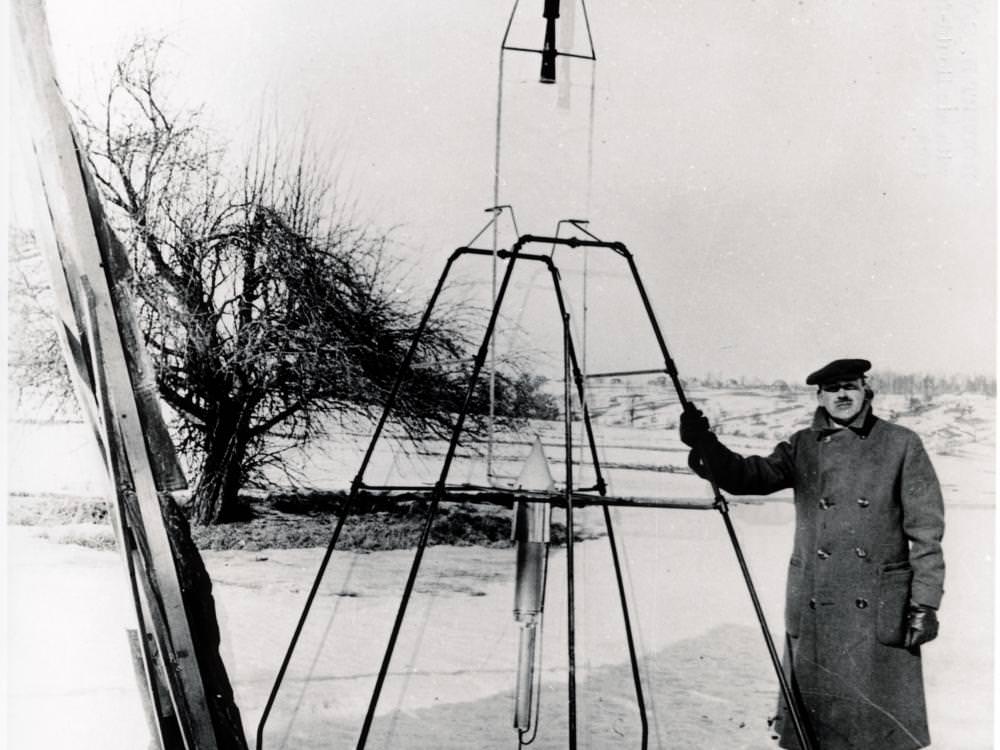
Against a stark winter landscape, a slender experimental rocket hangs from a simple launch rig, its metal body gleaming against snow and bare trees. The composition feels both improvised and daring: a tall tripod-like frame, wires and supports, and a quiet open field serving as an outdoor laboratory. In the distance, low hills and fence lines emphasize how early rocketry often began far from factories and formal test ranges.
Robert Goddard stands beside the apparatus in a heavy coat and cap, posed with the calm of an inventor who trusts his calculations even when the hardware looks precariously minimal. The rocket’s tapered form and small fins hint at aerodynamic thinking, while the suspended setup suggests careful attention to stability and ignition. Details like the rigging and the ground equipment underscore how much of the work in 1920s rocketry was hands-on experimentation—measuring, adjusting, and trying again.
For readers interested in inventions and the origins of spaceflight, “Rocket (1926) by Robert Goddard” offers a vivid window into a turning point in technology history. It captures the moment when the idea of powered flight was being extended beyond air into the realm of propulsion and trajectory—an early step on the long road toward modern rockets. As an archival-style image, it also invites close looking: the practical engineering, the field conditions, and the human presence that links a pioneering experiment to the aerospace age that followed.