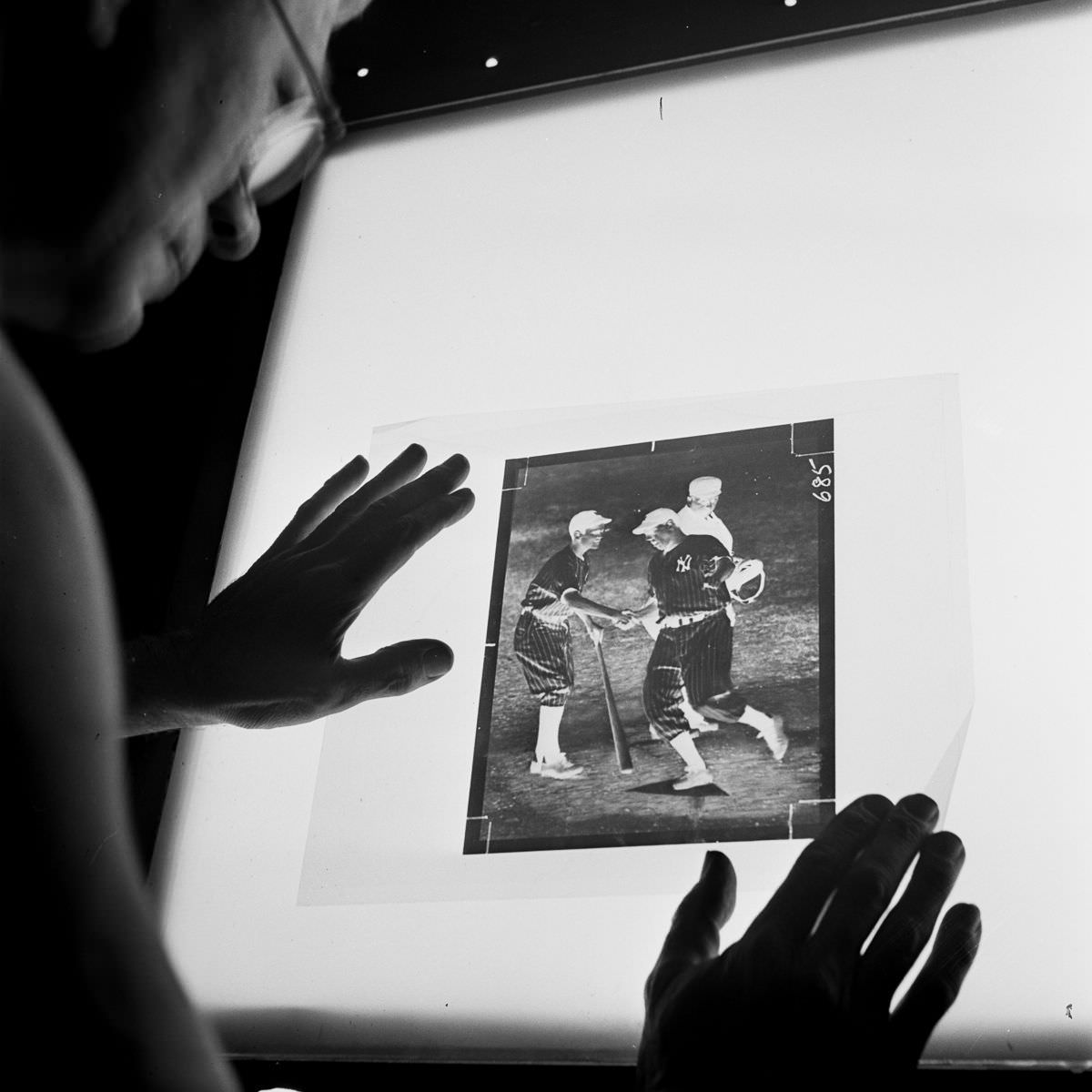
Under the glow of a light table, a darkroom technician leans in close, hands braced at the edges of a strip negative as if to steady both the film and the moment it contains. The scene on the negative—an action-filled sports frame with players mid-motion—feels almost secondary to the real subject here: the careful inspection of tiny dots on the screen that will determine how the image reproduces in print. In this intimate workshop view, craftsmanship takes center stage, turning photography into a precise, tactile form of engineering.
Before a photograph could land on a newspaper page or in a mass-circulation publication, it often had to pass through processes that translated continuous tones into patterns a press could handle. Those “dots” were the halftone language of print, and evaluating them meant checking density, clarity, and the way highlights and shadows would survive the jump from film to metal. The title’s mention of a transfer to a zinc plate points to photoengraving and early photomechanical reproduction—an era when images traveled from negative to plate to inked paper through a chain of skilled hands.
Even without naming a specific time or place, the photograph evokes the hidden labor behind everyday visual culture: the quiet rooms where technicians made sure the public would see a crisp image rather than a muddy blur. For anyone interested in inventions, printing history, or the evolution of photo reproduction, this is a reminder that innovation isn’t only found in cameras and presses, but also in the meticulous inspection that happens between them. The negative’s framed sports scene becomes a story about process—how modern media was built one dot at a time.