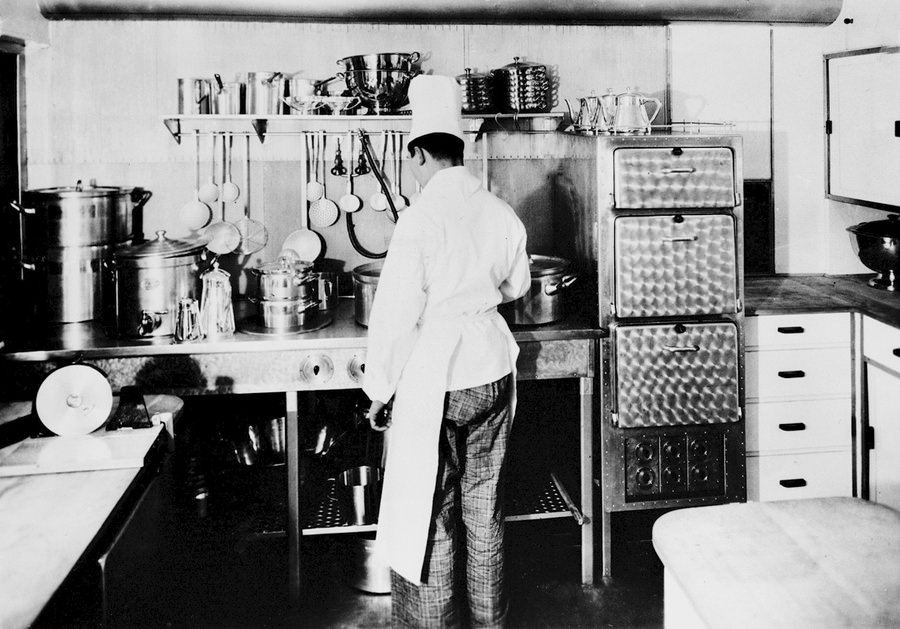
Stainless steel counters, a forest of hanging ladles, and tall stock pots give the galley on Hindenburg’s B Deck the feel of a compact industrial workshop rather than a romanticized airship kitchen. A chef in a crisp white coat and toque stands with his back to the camera, framed by orderly shelves of cookware and neatly stacked serving ware. The clean lines and bright surfaces underscore how modern passenger air travel was being imagined—efficient, hygienic, and quietly luxurious behind the scenes.
On the right, a bank of insulated cabinets and built-in controls hints at the engineering that made hot meals possible aloft, while drawers and worktops wrap the room in a practical U-shape. Utensils are placed within easy reach, suggesting a crew trained to cook in tight quarters with minimal wasted motion. Even without a view of the dining room, the galley’s precision speaks to the expectations of paying travelers: comfort delivered through disciplined service and reliable technology.
For readers interested in aviation history and the everyday life aboard famous airships, this photograph offers a rare look at the infrastructure that supported the grand experience. It’s a reminder that the story of the Hindenburg is not only about spectacle and headlines, but also about logistics—menus planned, dishes washed, and meals prepared in a space designed like a ship’s kitchen scaled for the sky. As an “inventions” moment in domestic engineering, the B Deck galley showcases how early airborne hospitality borrowed from maritime tradition while embracing modern materials and machine-like organization.