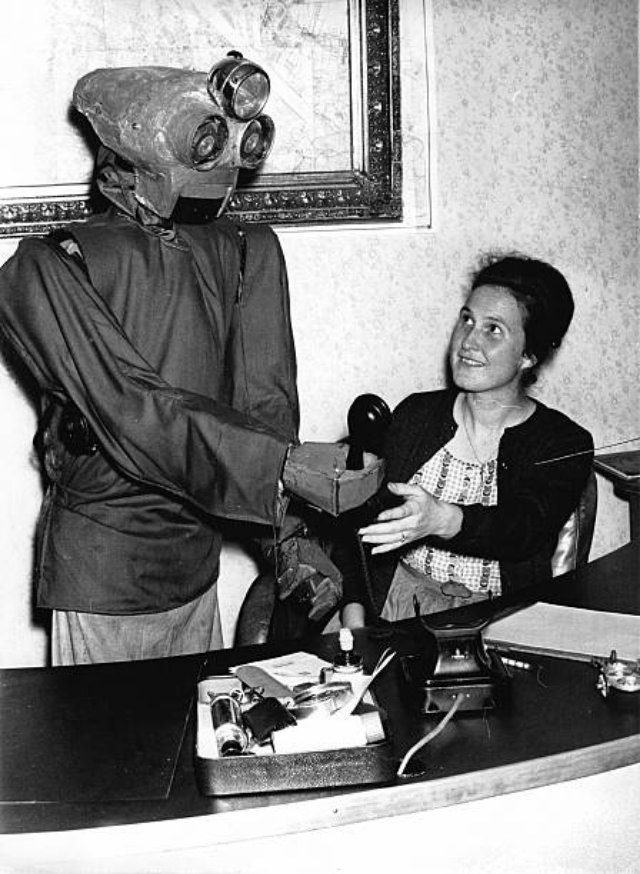
At a modest desk in a plainly decorated room, an ungainly “robot” leans in with oversized goggle-like optics and stiff, glove-shaped hands, extending what looks like a demonstration grip toward a seated woman. The scene has the staged, hopeful feel of mid-century invention culture: everyday furniture, a framed picture on the wall, and a contraption that seems part costume, part machine. On the tabletop, scattered tools and components hint at practical experimentation rather than science fiction—household automation imagined with whatever materials an inventor could assemble.
Claus Scholz-Nauendorff’s MM7 Selektor Robot, as the title suggests, was pitched as a breakthrough for domestic labor, and the photograph plays directly to that promise. The woman’s attentive smile and open posture read like a public trial of a labor-saving helper, even if the device’s bulky headgear and rigid mechanics reveal how early the idea still was. It’s a snapshot of ambition: the desire to “revolutionize housework” long before compact sensors, safe actuators, and quiet motors made home robots plausible.
Modern readers searching for the roots of home automation, early robotics history, and vintage invention photography will find a lot to linger over here. The MM7 Selektor Robot embodies a transitional moment when inventors tried to translate industrial notions of mechanized assistance into the private sphere, one carefully posed demonstration at a time. Seen today, the image is equal parts ingenuity and optimism—proof that the dream of a household robot has been evolving for generations, even when the first prototypes looked more like workshop experiments than future appliances.