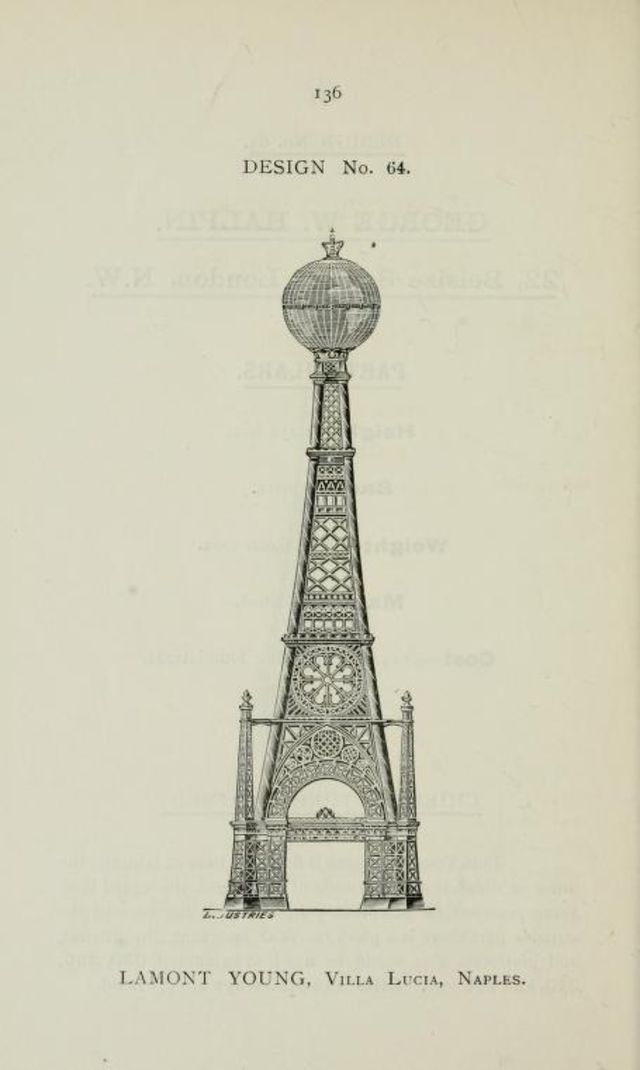
Ambition hangs in the air on this printed plate labeled “Design No. 64,” one of the many competitive proposals associated with the 1890 push for a “Great Tower for London.” The drawing rises in a tapering lattice of ironwork, punctuated by decorative bands and a large circular motif on the central section, all rendered with the precise, confident linework typical of late-19th-century engineering illustration.
At the summit, a striking spherical crown—almost like a globe or lantern—caps the structure and turns the tower into a statement piece as much as a feat of construction. The wide base and open arch suggest a monument meant to be entered and experienced from street level, echoing the era’s fascination with exhibition architecture, observation towers, and the idea that modern cities should advertise their progress in steel and ornament.
Beneath the image, the printed credit “Lamont Young, Villa Lucia, Naples” hints at how international these design competitions could be, drawing ideas from far beyond Britain even when the goal was a landmark for London. For readers interested in Victorian inventions, architectural history, and the creative rivalry behind unbuilt megastructures, this page offers a compelling snapshot of the imagination—and the marketing—behind grand proposals that competed to define a skyline.