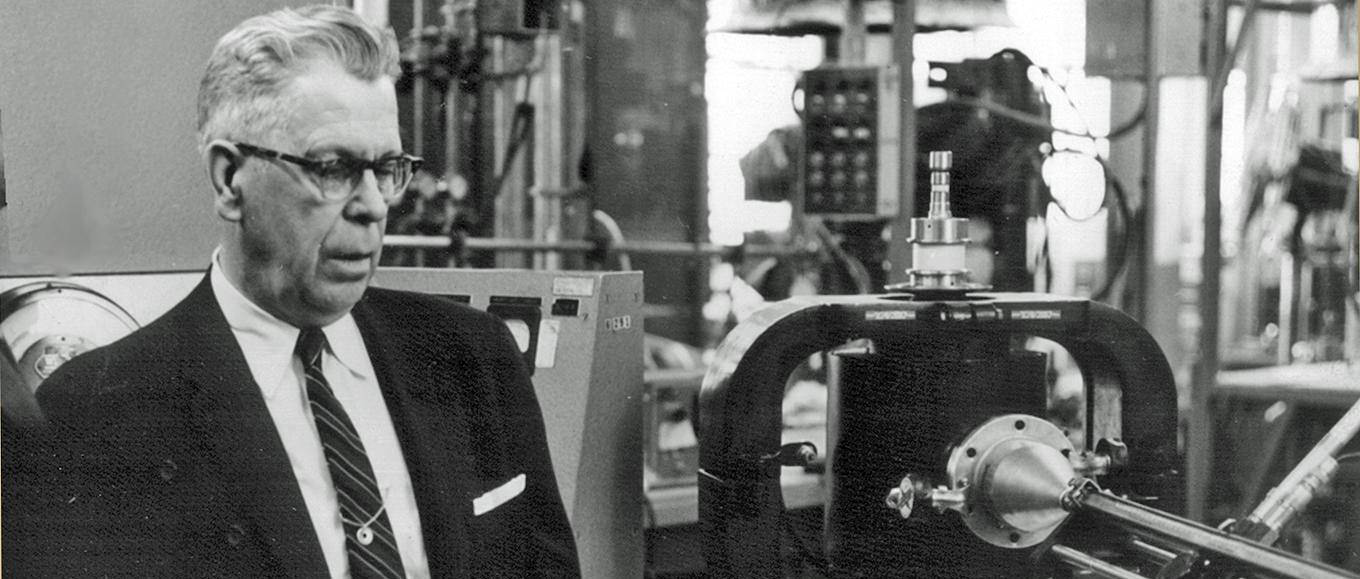
Serious-faced behind thick glasses, Percy Spenser stands beside a bulky piece of lab equipment that looks more like industrial hardware than a kitchen appliance. Cables, gauges, and metal housings crowd the background, placing the scene firmly in a research-and-development setting where postwar engineering was beginning to spill into everyday life. The title points to 1945, a moment when the idea of heating food with microwaves was still closer to experiment than convenience.
At the center sits a large magnetron assembly—the kind of component associated with radar work—mounted with sturdy brackets and connected to a protruding waveguide-like structure. The photograph emphasizes scale and complexity, reminding us that the early microwave oven was not a countertop gadget but a powerful, carefully controlled apparatus. In this frame, invention feels tactile: heavy metal, precise fittings, and a scientist-inventor watching the machine as if listening for proof it works.
Long before “microwave” became a household word, images like this captured the turning point when new energy technologies began reshaping domestic routines. Spenser’s presence underscores the human side of innovation: curiosity, patience, and the confidence to repurpose cutting-edge electronics for an entirely different use. For readers interested in inventions, food technology history, or the origins of the microwave oven, this photograph offers a stark, compelling glimpse of the device’s industrial beginnings.