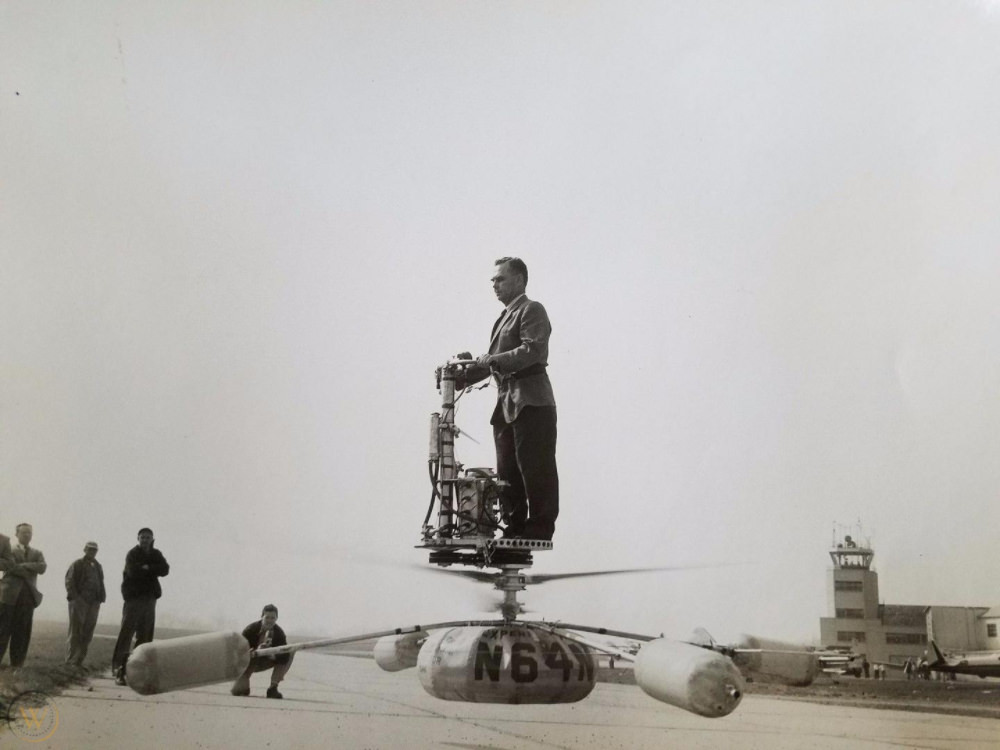
Perched upright on a narrow platform, a test pilot stands as if on a sidewalk curb—except the “curb” is the de Lackner HZ-1 Aerocycle, a one-man personal helicopter concept from the 1950s. Below his feet, the compact rotor system blurs into motion, while observers keep their distance on the airfield, watching a machine that looks more like an engineering sketch brought to life than a conventional aircraft. The stark simplicity is the point: minimal fuselage, minimal protection, and a bold promise of vertical flight for a single person.
What makes the scene so compelling is the tension between futuristic ambition and practical reality. With the pilot fully exposed and standing rather than seated, every gust, vibration, and control input would have been felt immediately, turning the flight test into a high-stakes balancing act. The Aerocycle’s skeletal frame, exposed mechanics, and utilitarian layout embody a mid-century faith that technology could shrink helicopters into personal transportation—an idea that captivated imaginations even as stability and safety remained stubborn problems.
Failure is part of the story here, and the title’s reminder of an unsuccessful flight test frames the photo as a snapshot of experimentation at the edge of what was feasible. For readers interested in Cold War-era inventions, aviation history, and unusual prototypes, the HZ-1 Aerocycle stands as an unforgettable example of how daring concepts are tested, corrected, and sometimes abandoned. This is the kind of rare historical image that captures both the optimism of the 1950s and the hard lessons learned on the runway.