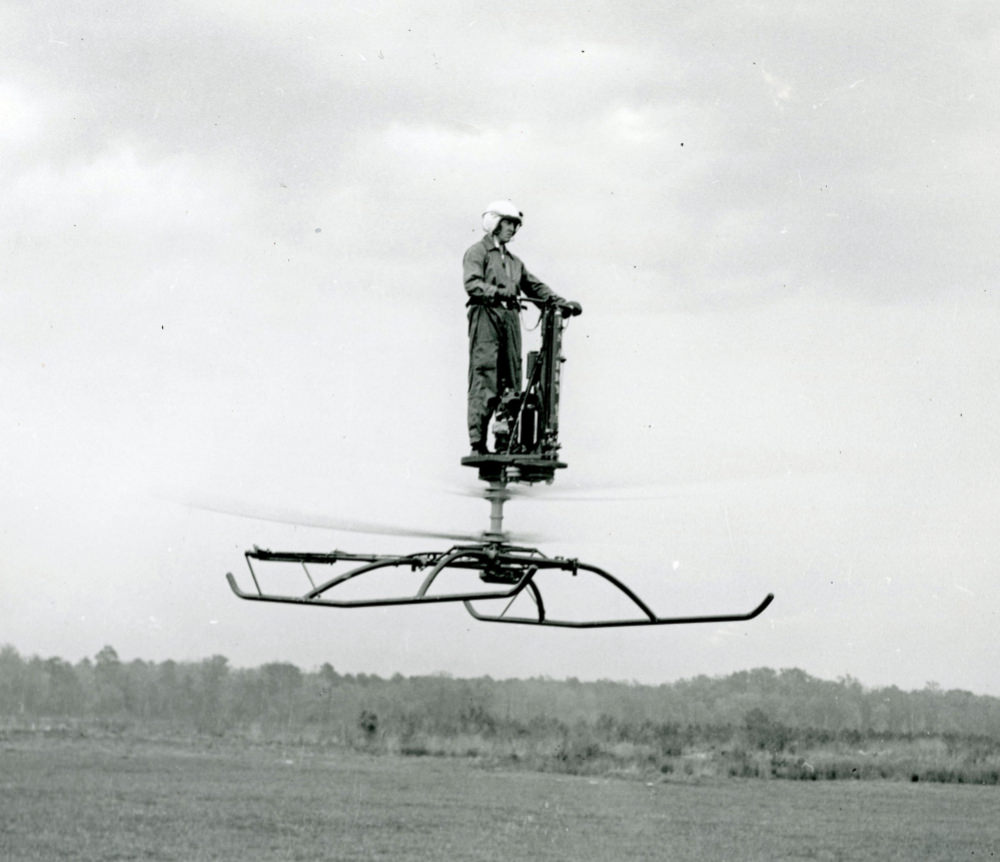
Balanced on a narrow platform above a whirring rotor, a helmeted test rider hovers over an open field with little more than a handrail and nerve between him and the ground. The de Lackner HZ-1 Aerocycle looks less like a conventional helicopter and more like a powered pedestal on landing skids, its sparse frame and exposed mechanics emphasizing just how experimental the concept was. In the distance, a low tree line and wide sky underline the era’s optimism that personal aviation might be made simple, portable, and soldier-proof.
The promise was straightforward: a one-man “personal helicopter” that could lift off quickly, skim low, and deliver mobility where roads and runways couldn’t. Yet the very features that made the Aerocycle so compact also made it unforgiving—an upright stance, a high center of gravity, and a minimal structure that offered scant protection or stability when conditions turned unpredictable. As the title hints, flight testing revealed hard limits, and the dream of a practical, mass-deployable platform ran into the realities of control, safety, and training.
For readers interested in Cold War-era inventions and the history of experimental aircraft, this photograph is a vivid reminder that progress often comes with dead ends as well as breakthroughs. The HZ-1 Aerocycle stands at the intersection of military innovation, engineering daring, and mid-century futurism, when designers repeatedly tried to shrink flight down to a single person and a simple machine. Even in failure, it helped define what personal vertical flight could not be—and why later rotorcraft and jet-powered concepts took different paths.