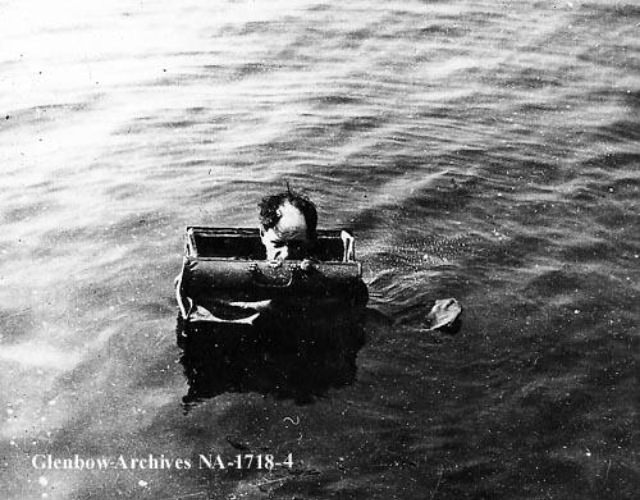
Out on open water, a lone figure bobs in a compact, boxlike float that looks suspiciously like everyday luggage. The scene is both odd and compelling: a man steadies himself at the rim while gentle ripples push past, making the “suitcase” appear just large enough to keep its occupant’s head and shoulders clear. It’s a vivid demonstration image, the kind meant to persuade skeptics that a clever design can turn a common travel object into emergency buoyancy.
John Edlund’s 1915-era invention, hinted at in the title, speaks to an age when maritime travel and shipboard safety were constant public concerns. Instead of relying on bulky gear stored out of reach, the promise here is immediacy—something portable, personal, and close at hand when disaster strikes. The photograph’s stark simplicity underscores the pitch: if a small case can become a lifeboat, then survival could be folded into the routines of packing and departure.
For readers interested in early 20th-century inventions, this post invites a closer look at how innovation often grew from practical fear and everyday materials. The waterline, the improvised craft, and the calm proof-of-concept feel like an advertisement staged as evidence, bridging imagination and engineering. As a piece of historical photography, it also captures a larger story about design thinking in 1915—when the boundary between ordinary possessions and lifesaving technology was being redrawn.