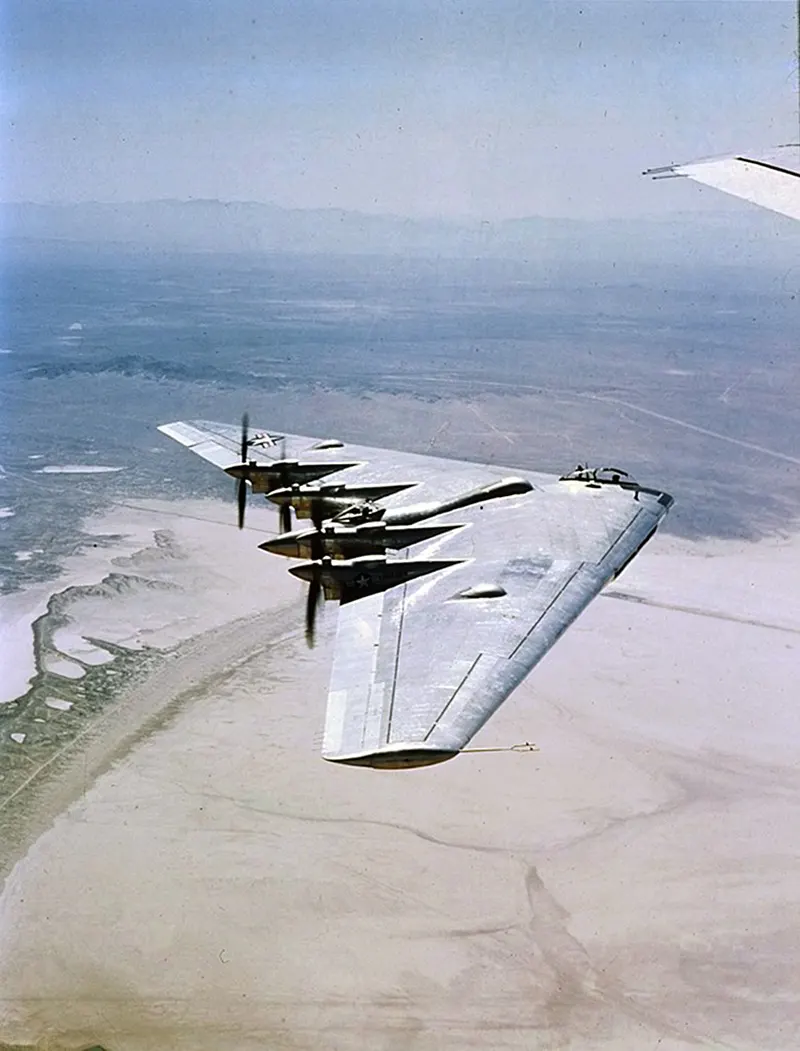
Sweeping across a pale desert basin, the YB-35 prototype looks less like a conventional bomber and more like a single, deliberate wing carved from metal. The absence of a long fuselage draws the eye to its broad planform and the clustered propellers, while the faint haze of distant mountains underscores just how high and steady this test flight had to be. Even in a simple archival frame, the aircraft’s radical “flying wing” silhouette reads as a bold wager on a new kind of aerodynamics.
Designed in an era when aviation inventiveness raced ahead of doctrine, the YB-35 embodied the promise—and risk—of experimental engineering. The pusher-prop arrangement, the smooth wing surfaces, and the integrated body all speak to the pursuit of efficiency: less drag, more lift, and potentially greater range for a heavy aircraft. Details like the U.S. markings and the aerial vantage point add authenticity without needing the crutch of captions, letting the prototype’s form tell the story of a program pushing boundaries.
Look closely and the photo becomes a snapshot of a transitional moment in military aviation history, perched between propeller-driven power and the coming dominance of jets. For readers interested in inventions, prototypes, and the evolution of stealthy, blended aircraft shapes, the YB-35 offers a compelling ancestor to later flying-wing designs. It’s a reminder that many of the most influential ideas first appeared as daring test articles, seen briefly over open country before the world decided what to do with them.