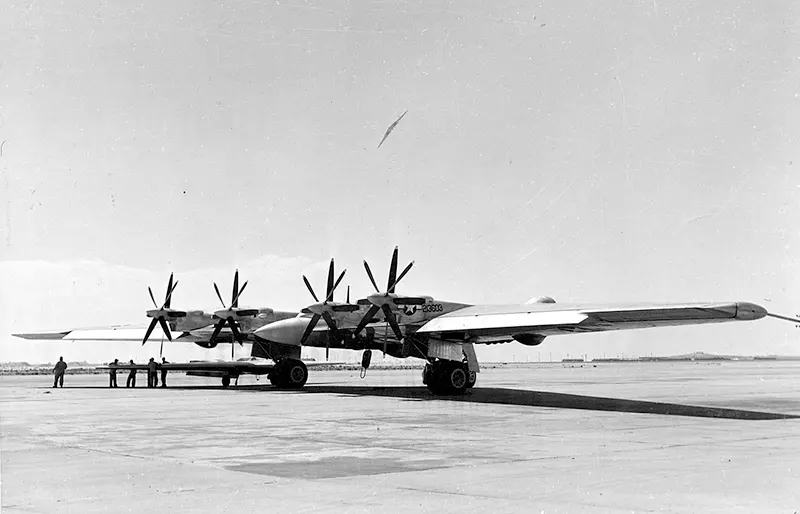
Across a wide concrete apron, the YB-35 Flying Wing rests like a sleek, unfinished idea made real—its broad span and low-slung profile emphasizing how radically different a flying wing looked beside conventional aircraft. The eye is drawn immediately to the quartet of pusher contra-rotating propellers clustered along the trailing edge, their paired blades creating a dense, almost mechanical halo against the pale sky. Small figures near the wing provide scale, underscoring the aircraft’s size and the ambition behind its clean, tailless form.
Those distinctive propellers were more than a visual signature; they represented a bold attempt to extract efficiency and performance from an unconventional airframe. Contra-rotating pairs promised to tame torque effects and squeeze more thrust from the engines while keeping the airplane’s silhouette streamlined. Yet the concept carried a hidden cost, and as the title notes, severe vibration in flight ultimately forced designers to abandon the arrangement and move toward a more traditional single-propeller configuration.
For readers interested in aviation history, experimental aircraft, and American aeronautical inventions, this photograph offers a crisp glimpse into the trial-and-error reality of cutting-edge development. The YB-35’s design choices—especially its pusher propellers—highlight a moment when engineers were willing to challenge nearly every assumption about bomber and transport layouts. Seen on the ground, the aircraft becomes a reminder that progress often arrives through discarded options as much as through celebrated breakthroughs.