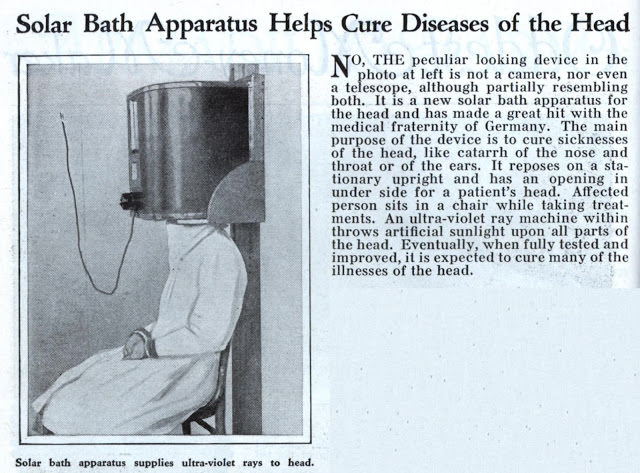
Bold headline typography promises that a “Solar Bath Apparatus” could help cure diseases of the head, setting the tone for an era when electricity and light were widely marketed as modern medicine. On the left, a patient sits in a simple chair while a tall, boxy cabinet stands close at hand, its mechanical presence more industrial than clinical. The setup feels halfway between laboratory experiment and beauty-salon contraption, designed to look authoritative even as it invites curiosity.
Reading the accompanying text reveals the selling point: an “ultra-violet ray machine” that throws artificial sunlight onto the head, with claims aimed at common complaints like catarrh and troubles of the throat or ears. The article carefully insists the device is neither camera nor telescope, suggesting how easily such apparatus could be mistaken for other modern instruments. That mix of reassurance and novelty is a hallmark of early medical innovation reporting, where the language of science tried to keep pace with public fascination.
As a piece of inventions history, the image highlights how “solar” and “bath” were used as soothing words for what is essentially a targeted light-therapy treatment. It also hints at the broader cultural belief that technological progress could be engineered into health, one machine at a time. For readers interested in vintage medical devices, ultraviolet therapy, and the evolution of wellness marketing, this Solar Bath Apparatus clipping offers a vivid glimpse into yesterday’s bright ideas.